Proposition 20.4.13. Let \(C\) be an admissible class of Waldhausen categories.
We consider a finite products preserving functor
\[
F\colon\WaldCat_C\to \An_{\bullet}\, .
\]
There is a canonical commutative square
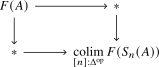 functorially in \(A\) and \(F\), that is cartesian whenever \(F\) is additive.
Proof
We observe that \(F(\Scons_0(A))\) is contractible for all \(A\) and thus, by virtue of
Lemma 20.4.12 there is a canonical equivalence of the form
\[
\underset{[n] : \Delta\catop}{\colim}\, F(\Scons_{n+1}(A))={*}
\]
The functorial embedding \(i_n\colon [n]\hookrightarrow [n+1]\) defined through the identification of \([n+1]\)
with \([0]\star[n]\) defines a functor
\[
i^*_n\colon\Scons_{n+1}(A)\to\Scons_n(A)
\]
functorially in \([n]\) and in \(A\).
We obtain a canonical commutative square of the form
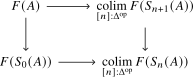 where the vertical maps are induced by the functors \(i^*_n\) above and the
horizontal maps are instances of the canonical map
\[
t_0\to \underset{[n] : \Delta\catop}{\colim}\, t_n
\]
for any functor \(t\colon\Delta\catop\to\An_{\bullet}\).
It suffices now to prove that the commutative square above is cartesian whenever \(F\) is
additive. By virtue of Lemma 13.4.4, it suffices to prove that, for any
additive functor \(F\colon\WaldCat_C\to\An_{\bullet}\),
and any map \(u\colon [m]\to [n]\) in \(\Delta\), the functor \(F\) sends the commutative square
of Waldhausen categories
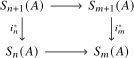 to a pullback square. We conclude this proof by observing thanks
to Corollary 20.4.11 that this commutative
square is equivalent to the commutative square
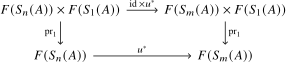 which is obviously cartesian.