Definition 20.5.1. A region is a finite poset \(R\) with pushouts.
If \(R\) is a region, we can define the length of a map \(x\leq y\) in \(R\): this is the maximal \(n : \N\) such that there exists an embedding \(u\colon [n]\hookrightarrow R\) with \(u(0)=x\) and \(u(n)=y\). Indeed, the decidable order on \(R\) gives decidable equality. After base change to a cardinal presentation of \(R^\simeq\), any such embedding satisfies \(n+1\leq |R^\simeq|\). The possible values of \(n\) and the corresponding embeddings therefore form a finite decidable collection, so this maximum exists. Its uniqueness ensures that it descends from the cover of cardinal presentations. An elementary square in \(R\) is a pushout square in \(R\) in which all maps are of length \(1\). An edge map in \(R\) is a map of length at least \(2\) that does not appear as the diagonal of an elementary square. An edge object of \(R\) is an object that is the source or the target of an edge map.
A morphism of regions is a functor (between regions) of the form \(f\colon R\to S\) that preserves pushout squares as well as edge objects.
A Waldhausen region is a region equipped with a family of maps closed under composition and under pushouts, called cofibrations (in a pedantic way, we could say that \([0]\star R\) is a pre-Waldhausen category). A morphism of Waldhausen regions is a morphism of regions that preserves cofibrations.
Example 20.5.2. For any \(m,n : \N\) the product \([m]\times [n]\) is a region with no edge object.
On the other hand, \([0]\star([m]\times [n])\) is a region whose unique edge object is the initial
object.
The elementary squares in \([m]\times [n]\) are those of the form
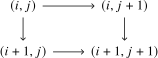 for all \(0\leq i<m\) and \(0\leq j<n\).
Unless stated otherwise, we will consider \([m]\times [n]\) as a Waldhausen region with cofibrations those
maps of the form \((i,j)\leq (i,k)\).
Example 20.5.3. For \(n : \N\), the category \(\Fun([1],[n])\) may be identified with the full subposet of
\([n]\times [n]\) whose objects are terms of the form \((i,j)\) with \(i\leq j\). This
description turns \(\Fun([1],[n])\) into a region whose edge objects are the identities, i.e.
the pairs of the form \((i,i)\) for any \(i : [n]^\simeq\).
The elementary squares in \(\Fun([1],[n])\) are those of the form
for all \(0\leq i< j< n\).
Unless stated explicitly otherwise, we will consider \(\Fun([1],[n])\) as a Waldhausen region
with cofibrations those
maps of the form \((i,j)\leq (i,k)\). This defines a functor
\[
[n]\mapsto\Fun([1],[n])
\]
from \(\Delta\) to the category of Waldhausen regions.
Definition 20.5.4. Let \(A\) be a Waldhausen category and \(R\) a Waldhausen region. We denote by \(\Scons(R,A)\) the full subcategory of \(\Fun(R,A)\) whose objects are those functors of the form \(x\colon R\to A\) with the following properties.
(i) The functor \(x\) preserves cofibrations.
(ii) The functor \(x\) preserves pushout squares.
(iii) The functor \(x\) sends edge objects to initial objects.
Remark 20.5.5. Any morphism of regions \(f\colon R\to Q\) induces a right exact functor \[ f^*\colon\Scons(Q,A)\to\Scons(R,A) \] obtained as the restriction of \(f^*\colon\Fun(Q,A)\to\Fun(R,A)\).
Construction 20.5.6. For any Waldhausen category \(A\) and any Waldhausen region \(R\), the category \(\Scons(R,A)\) has a natural structure of Waldhausen category. More precisely, the canonical embedding \(R\hookrightarrow [0]\star R\) induces an equivalence \[ \Scons([0]\star R,A)\simeq\Scons(R,A) \] and \(\Scons([0]\star R,A)\) may be seen as a full subcategory of \(\Wald([0]\star R,A)\) whose objects are the functors sending edge objects to initial objects. We define weak equivalences and cofibrations in \(\Scons(R,A)\) as those maps that have these properties when seen in \(\Wald([0]\star R,A)\).
Definition 20.5.7. We define a functor \[ \Scons\colon\WaldCat\to\Fun(\Delta\catop,\WaldCat) \] assigning to each \(A : \WaldCat\) and \([n] : \Delta\) the Waldhausen category \[ \Scons_n(A):=\Scons(\Fun([1],[n]),A)\, . \] We call \(S(A) : \Fun(\Delta\catop,\WaldCat)\) the Waldhausen \(S\)-construction associated with \(A\).
Lemma 20.5.8. Let \(A\) be a Waldhausen category and \(n : \N\). The fully faithful right exact functor \(u\colon[n]\hookrightarrow\Fun([1],[n])\) defined by \(u(i)=(0,i)\) induces an equivalence \[ u^*\colon\Scons_n(A)\iso\Wald([n],A)\, . \]
Proof
It suffices to check that
\[
u^*\colon
\Fun([1],\Scons_n(A))^\simeq\to\Fun([1],\Wald([n],A))^\simeq
\]
is an equivalence. Given any Waldhausen category \(B\),
we can equip \(\Fun([1],B)\) with a Waldhausen structure
in which the weak equivalences and the cofibrations are defined termwise.
We then observe that
\[
\Fun([1],\Wald([n],A))=\Wald([n],\Fun([1],A))\quad\text{and}
\Fun([1],\Scons_n(A))=\Scons_n(\Fun([1],A))\, .
\]
Therefore, we see that it suffices to prove that
\[
u^*\colon\Scons_n(A)^\simeq\to\Wald([n],A)^\simeq
\]
is an equivalence. This is done by induction on \(n\).
For \(n=0\), this is clear: both sides are contractible.
For \(n=1\), both sides are equivalent to \(A^\simeq\)
and \(u^*\) is equivalent to the identity of \(A^\simeq\).
Given \(n>0\) for which the statement is known to be true,
we deduce the case of \(n+1\) as follows.
Let \(R_n\) be the full subcategory of \(\Fun([1],[n+1])\)
whose objects are the pairs of the form \((i,j)\) with
\(j\leq n\) or \(i=0\). The embedding
\[
v\colon R_n\hookrightarrow\Fun([1],[n+1])
\]
induces an equivalence
\[
v^*\colon\Scons(\Fun([1],[n+1]),A)^\simeq\iso
\Scons(R_n,A)^\simeq
\]
whose inverse is given by completing each diagram of the form
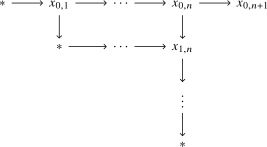 (in which \(x_{0,n}\to x_{0,n+1}\) is a cofibration) through pushouts (and a map to \(*\)).
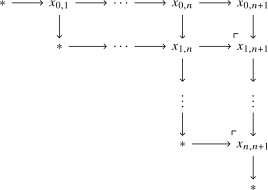 We see that there is a pullback square of the form
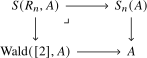 induced by the obvious embedding \(\Fun([1],[n])\hookrightarrow R_n\)
and the map \(w\colon [2]\hookrightarrow R_n\) defined by \(w(0)=(0,0)\),
\(w(1)=(0,n)\) and \(w(2)=(0,n+1)\).
Since there is a pullback of the form
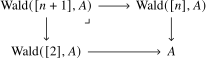 the induction hypothesis implies that there is a canonical equivalence
\[
\Scons(R_n,A)\simeq\Wald([n+1],A)\, .
\]
Remark 20.5.9. We may see the assignment \(A\mapsto A^\simeq\) as a functor of type \[ \WaldCat\to\An_\bullet\, . \] Using the canonical equivalence of type \([m]\times\Fun([1],[n])=\Fun([1],[n])\times [m]\), we get a canonical equivalence of type \[ \Scons_m(w_m(A))=w_m(\Scons_n(A)) \] for all \(A : \WaldCat\). We will simply write \[ w_m\Scons_n(A):=w_m(\Scons_n(A)) \] and denote \[ w\Scons(A)\colon\Delta\catop\times\Delta\catop\to\An_{\bullet}\, . \] We thus get a functor \[ w\Scons\colon\WaldCat\to\Fun(\Delta\catop\times\Delta\catop,\An_{\bullet})\, . \] Recall that the universal left fibration \(\An_\bullet\to\An\) commutes with colimits indexed by small weakly contractible categories, in particular with small sifted colimits.
Definition 20.5.10. Given a Waldhausen category \(A\), we define the \(K\)-theory of \(A\) as the pointed anima \[ K(A):=\Omega\Big(\underset{[m] : \Delta\catop}{\colim}\, \underset{[n] : \Delta\catop}{\colim}\, w_m\Scons_n(A)^\simeq\Big)\, . \]