Proposition 20.4.10. Let \(F\colon\WaldCat_C\to D\) be an additive functor. We consider two morphisms \[ p\colon A\to A'\quadtext{and} q\colon A\to A'' \] in \(\WaldCat_C\) together with the following extra data.
(i) There are given maps \(i\colon A'\to A\) and \(j\colon A''\to A\) such that \(i\) is a section of \(p\) and \(j\) a section of \(q\).
(ii) Each composition \(p\circ j\) and \(q\circ i\) vanishes (i.e. is isomorphic to the constant functor with value the terminal object).
(iii) There is given a map \[ \varphi\colon A\to\ExactSeq(A) \] so that \(\varphi(x)\) is an exact sequence of the form
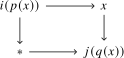 for all \(x : A\).
Then \(p\) and \(q\) together induce an equivalence of type
\[
F(A)=F(A')\times F(A'')\, .
\]
Proof
Since \(p\) and \(q\) commute with finite coproducts, condition (ii)
ensures that the functor
\[
u\colon A'\times A''\to A\ , \quad (x,y)\mapsto i(x)\amalg j(y)
\]
defines a section of the functor
\[
(p,q)\colon A\to A'\times A''\, .
\]
It suffices to check that the composition of \(u\circ (p,q)\) becomes the identity of \(F(A)\) after
applying \(F\).
We define a functor
\[
\psi\colon A\to\ExactSeq(A)
\]
by the rule below.
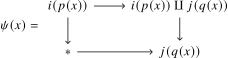 Since postcomposing with \((\ker,\coker)\) turns \(\varphi\) and \(\psi\) equal,
we have an equality of type \(F(\varphi)=F(\psi)\).
Let \(p\colon\ExactSeq(A)\to A\) be the functor defined by the rule
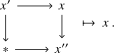 Since \(p\circ \varphi=\id_A\) and \(p\circ \psi=u\circ (p,q)\),
this shows that \(F(p,q)\) is invertible.