Theorem 12.8.1 (Kan). Let \(A\) be a small synthetic category and \(C\) any synthetic category with small colimits. For each functor \(u\colon A\to C\), there is a functor that commutes with small colimits \[ Lu_!\colon\PSh(A)\to C \] equipped with a canonical identification \[ Lu_! \circ h_A \simeq u \] of functors from \(A\) to \(C\). Furthermore, if \(C\) is locally small, the functor \(Lu_!\) is left adjoint to the functor \[ u^*h_C\colon{C}\to\PSh(A)\ , \quad y\mapsto\Hom_C(u(-),y)\, . \]
Proof
We choose a universe of large animae \(\An'\) and
we write \(\PSh(D)'=\Fun(D\catop,\An')\) for the category of
functors from a category \(D\) with values in \(\An'\).
The functor
\[
u_!\colon\PSh(A)'\to\PSh(C)'
\]
commutes with (small) colimits (being a left adjoint). We have a commutative square of the following form.
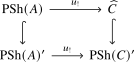 This implies that the induced functor
\[
u_!\colon\PSh(A)\to\widehat{C}
\]
preserves colimit cocones indexed by small categories.
The functor
\[
L\colon\widehat{C}\to C
\]
is a left adjoint by Lemma 12.7.2, hence preserves
all colimits. This implies that the composite \(Lu_!\) preserves small colimits.
If furthermore \(C\)is locally small then Lemma 12.7.5 tells us that \(u_!\) is a left adjoint to \(u^*\). Since \(L\) is a left adjoint to the small Yoneda embedding, the composite \(Lu_!\) is a left adjoint to \(u^* h_C\).
From Section 12.8, Presheaf categories as free cocompletions.