Lemma 13.3.4. Let \(I\) be small and \(X\colon I \to \PSh(C)\). Consider the pullback
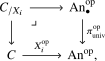 which provides a functor \(I \to \Cat\), \(i \mapsto C_{/X_i}\). Then there is a canonical equivalence
\[
\colim_{i \in I} C_{/X_i} \iso C_{/(\colim_{i \in I} X_i)}.
\]
Proof
We start with some observations:
• The functor \(\Cat_{/C} \to \Cat, (X,p) \mapsto X\) preserves colimits, since it admits a right adjoint \(C \times -\colon \Cat \to \Cat_{/C}\). Furthermore this functor is conservative. Hence we may compute this colimit either in \(\Cat_{/C}\) or \(\Cat\).
• The category \(\PSh(C)\) is equivalent to the full subcategory \(\RFib(C) \subseteq \Cat_{/C}\) consisting of the right fibrations. This equivalence is given by sending \(X\) to \((C_{/X}, p_X\colon C_{/X} \to C)\).
• So it will suffice to show that \(\colim_{i \in I} C_{/X_i}\), computed in \(\Cat_{/C}\), is still contained in \(\RFib(C)\), since then it must also be a colimit in \(\RFib(C)\) and hence correspond to the colimit of the \(X_i\) in \(\PSh(C)\).
Put \(E:=\int_{i\in I}C_{/X_i}\), and write \(p\colon E\to C\) and \(r\colon E\to I\) for the two projections. By Lemma 13.3.3, the functor \(p\) is a cartesian fibration. By Theorem 13.2.1, the colimit \(\colim_i C_{/X_i}\) is obtained from \(E\) by inverting the \(r\)-cocartesian morphisms. Every such morphism maps to an isomorphism in \(C\). Conversely, a morphism of \(E\) whose image in \(C\) is an isomorphism factors as an \(r\)-cocartesian morphism followed by a morphism in some \(C_{/X_j}\) lying over an isomorphism in \(C\); the latter is an equivalence because \(C_{/X_j}\to C\) is a right fibration. Thus this colimit is also the localization of \(E\) at all morphisms mapped by \(p\) to isomorphisms. Applying Corollary 12.4.12 with the subcategory \(W=E\) shows that the induced functor \[ \colim_i C_{/X_i}\longrightarrow C \] is a cartesian fibration. Its fiber over \(c\colon *\to C\) is the localization of \(\int_i X_i(c)\) at all its morphisms. Every such morphism factors as a cocartesian morphism followed by a vertical morphism, and the vertical morphism is an equivalence because each \(X_i(c)\) is an anima. This is therefore the localization at the cocartesian morphisms, hence the anima \(\colim_i X_i(c)\). Thus all its fibers are animae, so it is a right fibration. Under straightening, its fiber at \(c\) is \(\colim_i X_i(c)\), and it therefore classifies the pointwise colimit \(\colim_i X_i\).