Definition 3.2.4 (Collection of objects). Consider a category \(C\). A collection of objects is a pair \((\Gamma,j)\) consisting of an anima \(\Gamma\) equipped with an embedding \(j\colon \Gamma \hookrightarrow C^{\simeq}\). In this case, we define an anima \(M_{\Gamma}\) via the following pullback:
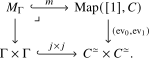 The map \(m\) is an embedding, as it is a base change of the embedding \(j \times j\). The resulting collection \(M_{\Gamma}\) is closed under composition: the identity of an object represented by \(\Gamma\) again has both endpoints in \(\Gamma\), and the composite of two composable morphisms with endpoints represented by \(\Gamma\) has the same property. This allows us to make the following definition: