Remark 18.7.8. Let \(C\) be a category with pushouts.
We denote by
\[
1^*=\ev_1\colon\Fun([1],C)\to C
\]
the functor assigning to a map of \(C\) its codomain.
The existence of an initial object \(*\) in \(C\)
amounts to the existence of a left adjoint
\[
1_!\colon C\to\Fun([1],C)
\]
of \(1^*\). Indeed, if \(*\) is initial in \(C\),
given a morphism \(u\colon x\to y\) in \(C\) and a term \(a\) in \(C\),
there is an obvious correspondence of the form
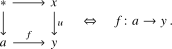 Conversely, a correspondence as above for some object \(* : C^\simeq\)
implies in the particular case \(a:=y\) and \(u:=\id_y\) that there is a unique map from \(*\) to \(y\)
for any \(y : C^\simeq\). This computation also shows that the left adjoint \(1_!\)
sends an object \(x\) to the unique map of type \(*\to x\).
The property that the initial object \(*\) of \(C\) is also terminal is equivalent to the property that
the functor \(1_!\) itself has a left adjoint
\[
1^?\colon\Fun([1],C)\to C\, .
\]
Indeed, if \(*\) is also terminal, the dual version of the preceding observation
tells us that the functor
\[
0^*=\ev_0\colon\Fun([1],C)\to C
\]
has a right adjoint
\[
0_*\colon C\to\Fun([1],C)
\]
assigning to each term \(x\) of \(C\) the unique map of type \(x\to *\).
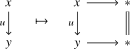
The identity of \(*\) being both an initial object and a terminal object of \(\Fun([1],C)\),
the functor
\[
0_*\colon\Fun([1],C)\to\Fun([1],\Fun([1],C))
\]
yields the assignment
 Since \(C\) has pushouts, the full embedding \(i\colon\pushout\hookrightarrow\square\)
induces an adjunction
\[
i_!\colon\Fun(\pushout,C)\rightleftarrows\Fun(\square,C)\colon i^*
\]
where \(i_!\) sends a diagram of the form \(b\leftarrow a\to c\) in \(C\) to the corresponding
pushout square
 With these conventions, the functor \(1^?\) is constructed as \(i_!\circ i^*\circ 0_*\). In other words, it sends
a map \(u\colon x\to y\) in \(C\) to
the pushout square
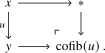 The object \(1^?(u)=\cofib(u)\), also known as the cofiber of the morphism \(u\),
is thus the evaluation at the terminal object of
\(\square=[1]\times[1]\) of \(i_!(0_*(u))\).
Conversely, if \(C\) has an initial object and if \(1_!\) has a further left adjoint \(1^?\), since \(1_!\) is fully faithful with image those maps of the form \(*\to x\), applying \(0^*\) to the unit map \[ \eta_u \colon u\to 1_!\, 1^?(u) \] yields for \(u=\id_x\) a unique map \(x\to *\) for all \(x : C^\simeq\), hence \(*\) is a terminal object of \(C\).