Recall the notion of compact object (Definition 16.3.6).
Definition 18.1.1. Let \(C\) be a locally small category with small filtered colimits. An object \(x : C^\simeq\) is compact if the functor \[ \Hom_C(x,-)\colon C\to \An \] commutes with small filtered colimits.
We denote by \(C_\omega\) the full subcategory of \(C\) whose collection of objects consists of the compact objects of \(C\).
Example 18.1.2. If \(A\) is a small category and \(a : A^\simeq\), then \(\Hom_A(-,a)\) is a compact object of \(C=\PSh(A)\). Indeed, by virtue of the Yoneda Lemma, this amounts to claiming that the functor \(F\mapsto F(a)\) commutes with filtered colimits, which is due to the fact that it commutes with all colimits.
Lemma 18.1.3. Let \(C\) be a locally small category with small colimits. The full subcategory \(C_\omega\) has finite colimits and the full embedding \(C_\omega\hookrightarrow C\) is a right exact functor.
Proof
By virtue of Proposition 16.4.12 and
Proposition 16.4.13,
this amounts to saying that the initial object is compact and that, for any pushout square of \(C\) of the form
 with \(a\), \(b\) and \(a'\) compact, the object \(b\) is compact.
Indeed, if \(c : C\) is initial, then the functor \(\Hom_C(c,-)\) is the constant functor
with value the terminal object of \(\An\). Claiming that \(c\) is compact amounts to claiming that,
for any small filtered category \(I\), the \(I\)-indexed colimit functor preserves terminal objects
in \(\An\), which follows from the fact that, by definition, filtered categories are weakly
contractible. As for the second assertion, we observe that, for any small filtered category \(I\),
and for any functor \(i\mapsto x_i\) with values in \(C\),
we have the following immediate computations, using the very definition of compactness together with
Theorem 16.2.9.
\begin{align*}
\underset{i : I}{\colim}\Hom_C(b',x_i)
&=\underset{i : I}{\colim}\Big(\Hom_C(a',x_i)\times_{\Hom_C(a,x_i)}\Hom_C(b,x_i)\Big)\\
&=\underset{i : I}{\colim}\Hom_C(a',x_i)
\times_{\underset{i : I}{\colim}\Hom_C(a,x_i)}
\underset{i : I}{\colim}\Hom_C(b,x_i)\\
&=\Hom_C(a',\underset{i : I}{\colim}\, x_i)
\times_{\Hom_C(a,\underset{i : I}{\colim}\, x_i)}
\Hom_C(b,\underset{i : I}{\colim}\, x_i)\\
&=\Hom_C(b',\underset{i : I}{\colim}\, x_i)
\end{align*}
Definition 18.1.4. Let \(C\) be a locally small category and \(S\hookrightarrow\Map([1],C)\) a family of morphisms in \(C\). An object \(x : C^\simeq\) is said to be \(S\)-local if, for any map \(f\colon a\to b\) belonging to \(S\), the induced map \[ f^*\colon C(b,x)\to C(a,x) \] is an equivalence.
We denote by \(L_S(C)\) the full subcategory of \(C\) spanned by \(S\)-local objects.
A morphism \(f\colon a\to b\) in \(C\) is called an \(S\)-equivalence if, for any \(S\)-local object \(x\), the induced map \[ f^*\colon C(b,x)\to C(a,x) \] is an equivalence.
Proposition 18.1.5. Let \(C\) be a locally small category with small filtered colimits. If \(S\) is a family of morphisms between compact objects of \(C\), then \(L_S(C)\) has small filtered colimits and the full embedding \(L_S(C)\hookrightarrow C\) commutes with small filtered colimits. In other words: any small filtered colimit of \(S\)-local objects in \(C\) is an \(S\)-local object.
Proof
This is straightforward.
The main goal of this section is to prove the theorem below.
Theorem 18.1.6. Let \(C\) be a locally small category with small colimits and \(S\hookrightarrow\Map([1],C_\omega)\) a small family of maps between compact objects of \(C\). Then the full embedding \(L_S(C) \hookrightarrow C\) has a left adjoint \[ \loc_S\colon C\to L_S(C) \] exhibiting \(L_S(C)\) as the localization of \(C\) by the family of \(S\)-equivalences. Furthermore, the functor \(\loc_S\) preserves compact objects.
The proof of this theorem will need a little bit of preparation. Fix \(C\) locally small with filtered colimits.
Definition 18.1.7. A family of morphisms \(S\hookrightarrow\Map([1],C)\) is codiagonal-stable if, for any
map \(u\colon a\to b\) in \(S\), if we form the pushout square
 then the codiagonal map \(v\colon b\amalg_a b\to b\) induced by the obvious commutative square
 belongs to \(S\).
Lemma 18.1.8. If \(S\) is codiagonal-stable, then an object \(x : C^\simeq\) is \(S\)-local if and only if, for any map \(u\colon a\to b\) in \(S\), the induced map \[ u^*\colon\Hom_C(b,x)\to\Hom_C(a,x) \] has a section.
Proof
This is clearly a necessary condition. Conversely, let us consider an object \(x\) with the property that \(u^*\)
has a section for any \(u : S\).
We observe that, for any map \(u\colon a\to b\) in \(S\),
the codiagonal map \(v\colon b\amalg_ab\to b\) has a section, hence
\[
v^*\colon\Hom_C(b,x)\to\Hom_C(b\amalg_ab,x)
\]
is a section. In other terms, \(v^*\) has a left inverse as well as a right inverse and is thus
an equivalence. In other words, for any \(u\colon a\to b\) in \(S\),
the induced commutative square
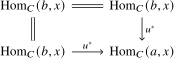 is a pullback square. This means that the map \(u^*\colon\Hom_C(b,x)\to\Hom_C(a,x)\) is an embedding.
Since \(u^*\) also is a cover, it must be an isomorphism, by Proposition 11.2.10.
Lemma 18.1.9. The family of \(S\)-equivalences has the following stability properties.
(i) It has the \(2\)-out-of-\(3\) property.
(ii) It is stable under small colimits: for any small category \(I\) and any functors \(a,b\colon I\to C\) and any natural transformation \[ u\colon a\to b\, \] if \(u_i\colon a_i\to b_i\) is an \(S\)-equivalence for any object \(i : I^\simeq\), then the induced morphism \[ \underset{i : I}{\colim}\, u_i\colon \underset{i : I}{\colim}\, a_i \to \underset{i : I}{\colim}\, b_i \] is an \(S\)-equivalence.
(iii) For any pushout square in \(C\) of the form
with \(u\) an \(S\)-equivalence, the morphism \(u'\) is an \(S\)-equivalence.
Proof
Properties (i) and (ii) are straightforward (they follow right away from
the analogous properties for the family of isomorphisms in \(\An\), using the fact that the functor
\(\Hom_C(x,-)\) commutes with small limits for any object \(x\)).
As for property (iii), we simply observe that
we have an induced pullback square of the form
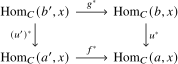 proving that \(u'\) is an \(S\)-equivalence whenever \(u\) has this property.
Construction 18.1.10. Let \(S\hookrightarrow\Map([1],C)\) be a family of maps in \(C\). We define \(\nabla(S)\) as the union in \(\Map([1],C)\) of \(S\) with the image of the map \[ \kappa\colon S\to \Map([1],C) \] that assigns to each \(u\colon a\to b\) in \(S\) the associated codiagonal \(\kappa(u)=v\colon b\amalg_ab\to b\). We define a sequence of embeddings of anima \[ S_0\hookrightarrow S_1\hookrightarrow\cdots\hookrightarrow S_n\hookrightarrow S_{n+1}\hookrightarrow\cdots \] by defining \(S_0=S\) and \(S_{n+1}=\nabla(S_n)\) for all \(n : \N\). We put \[ \bar{S}=\underset{n : \omega}{\colim}\, S_n\, . \]
Lemma 18.1.11. Assume that \(S\hookrightarrow\Map([1],C)\) is a small family of maps between compact objects. Then the following properties hold.
(i) The family \(\bar S\) is a small family of maps between compact objects.
(ii) The family \(\bar{S}\) is codiagonal-stable.
(iii) An object \(x : C^\simeq\) is \(S\)-local if and only if it is \(\bar{S}\)-local.
Proof
It is clear that \(\nabla(S)\) is small whenever \(S\) is small. Therefore, each \(S_n\) is small. Since small animae are stable under \(\omega\)-indexed colimits, this proves that \(\bar{S}\) is small. The second part of property (i) follows right away from Lemma 18.1.3. The property for \(\bar{S}\) to be codiagonal-stable amounts to the property that \(\bar{S}\) contains \(\nabla(\bar{S})\), which holds by construction. Finally, it is clear that any \(\bar{S}\)-local object is \(S\)-local because \(S\) is a subfamily of \(\bar{S}\) by construction. Conversely, it suffices to prove that any \(S\)-local object \(x\) is also \(\nabla(S)\)-local, which follows right away from properties (i) and (iii) of Lemma 18.1.9.
Proof of Theorem 18.1.6 through the small object argument
By virtue of Lemma 18.1.11, we may assume that \(S\) is codiagonal-stable. We define a functor \[ L\colon C\to C \] as well as a natural transformation \(l\colon \id_C\to L\) as follows. There is a functor \[ \An\times C\to C \ , \quad (a,x)\mapsto a\otimes x \] defined by the functorial formula \[ \Hom_C((a\otimes x)\catop,y)=\Hom_\An(a\catop,\Hom_C(x\catop,y)) \] for \(a : \An\) and \(x,y : C\). More precisely, if \(a\) is an anima and \(x\) an object of \(C\), then \(a\otimes x\) is the \(a\)-indexed colimit of the constant diagram with value \(x\).
Given \(x : C\) and an object \(a\) of \(C\), there is thus a canonical map
\[
c_{a,x}\colon \Hom_C(a,x)\otimes a\to x
\]
corresponding to the identity of \(\Hom_C(a,x)\), functorially in \(x\).
We define \(A(x)\) as the colimit indexed by \(S\) of the diagram that assigns \(\Hom_C(a,x)\otimes a\)
for each term \(u\colon a\to b\) of \(S\). Similarly, we define \(B(x)\) as the
colimit indexed by \(S\) of the diagram that assigns \(\Hom_C(a,x)\otimes b\)
for each term \(u\colon a\to b\) of \(S\). We define
\[
\alpha_x\colon A(x)\to x
\]
as the map induced by the family \(c_{a,x}\) indexed by each term \(u\colon a\to b\) of \(S\).
We form the pushout square
 where \(i_x\) is the \(S\)-indexed colimit of the maps
\[
\id\otimes\, u\colon \Hom_C(a,x)\otimes a\to \Hom_C(a,x)\otimes b\, .
\]
We now define a sequence of functors
\[
L^0\xrightarrow{l^1}L^1\xrightarrow{l^2}\cdots\to L^n\xrightarrow{l^{n+1}}L^{n+1}\to\cdots
\]
by induction through the formulas
\[
L^0=\id_C\quad\text{and}\quad L^{n+1}=L\circ L^n\ , \quad l^{n+1}=l_{L^n}\, .
\]
We define
\[
\lambda_x\colon x\to \loc_S(x)
\]
functorially in \(x\) by the formula
\[
\loc_S(x)=\underset{n : \omega}{\colim}\, L^n(x)
\]
with \(\lambda_x\) the map induced by the component of the colimit cocone at \(0 : \N\).
It follows from Lemma 18.1.9 that \(l_x\) is an \(S\)-equivalence
for all \(x\). We can also see the map \(\lambda_x\) as the \(\omega\)-indexed colimit of the natural
transformation
 in which the vertical maps are \(S\)-equivalences (this is proven by induction, as finite compositions of maps of the form \(l_y\) for various \(y\)’s). Therefore, Lemma 18.1.9 (ii) implies that \(\lambda_x\) is an \(S\)-equivalence for any \(x\).
We claim that \(\loc_S(x)\) is \(S\)-local. Indeed, for any \(u\colon a\to b\) in \(S\), and for any \(n : \N\), there is
a canonical commutative diagram of the form
 in which the dashed arrow \(\lambda_n\) is induced by the map \(\beta_{L^n(x)}\).
We can think of the collection of the maps \(\lambda_n\) as a morphism of sequences of morphisms of anima:
 Taking the associated Milnor colimits yields a morphism
\[
\lambda'\colon\underset{n : \omega}{\colim}\, \Hom_C(a,L^n(x))
\to\underset{n : \omega}{\colim}\, \Hom_C(b,L^{n+1}(x))\, .
\]
Since \(\omega\) is filtered, the embedding \(\omega_{1/}\to\omega\) is terminal, hence
we have
\[
\underset{n : \omega}{\colim}\, \Hom_C(b,L^{n+1}(x))=
\underset{n : \omega}{\colim}\, \Hom_C(b,L^{n}(x))\, .
\]
The map \(\lambda'\) thus yields a map
\[
\lambda\colon\underset{n : \omega}{\colim}\, \Hom_C(a,L^n(x))
\to\underset{n : \omega}{\colim}\, \Hom_C(b,L^{n}(x))\, .
\]
Since \(\Hom_C(t,\loc_S(x))\) canonically is the colimit of the \(\Hom_C(t,L^n(x))\)’s for any compact object \(t\),
the map \(\lambda\) determines a map
\[
\bar{\lambda}\colon\Hom_C(a,\loc_S(x))\to\Hom_C(b,\loc_S(x))
\]
that is a section of the map
\[
u^*\colon\Hom_C(b,\loc_S(x))\to\Hom_C(a,\loc_S(x))
\]
by construction. Lemma 18.1.8 thus proves that \(\loc_S(x)\)
is \(S\)-local.
Consider now an \(S\)-local object \(y\) in \(C\). Then, for any object \(x : C^\simeq\), the \(S\)-equivalence \(\lambda_x\) induces an isomorphism \[ \lambda^*_x\colon\Hom_C(\loc_S(x),y)\xrightarrow{\simeq}\Hom_C(x,y)\, . \] Since this equivalence is obviously functorial in \(y\), this shows that the full embedding of \(L_S(C)\) into \(C\) is a right adjoint by Theorem 12.3.20.
The characterization of \(L_S(C)\) as localization of \(C\) by \(S\)-equivalences follows from Proposition 4.4.16 and from Corollary 12.3.14 applied to \(L_S(C)\).
It remains to prove that the left adjoint \(\loc_S\) preserves compact objects. Let \(x : C^\simeq\) be a compact object. We consider a small filtered category \(I\) as well as an \(I\)-indexed functor \(i\mapsto y_i\) with values in \(L_S(C)\). We know from Proposition 18.1.5 that the colimit of the diagram of the \(y_i\)’s can be computed independently in \(L_S(C)\) or in \(C\) itself. In other words, we have \begin{align*} \underset{i : I}{\colim}\, \Hom_{L_S(C)}(\loc_S(x),y_i) &= \underset{i : I}{\colim}\, \Hom_{C}(x,y_i)\\ &= \Hom_{C}(x,\underset{i : I}{\colim}\, y_i)\\ &= \Hom_{L_S(C)}(\loc_S(x),\underset{i : I}{\colim}\, y_i)\, , \end{align*} thus proving that \(\loc_S(x)\) is a compact object of \(L_S(C)\).
Recall that \(\Fun_!(C,D)\) is the full subcategory \(\Fun(C,D)\) spanned by functors commuting with small colimits.
Corollary 18.1.12. Let \(C\) be a locally small category with small colimits and \(S\) a small family of morphisms between compact objects of \(C\), with associated localization functor \[ \loc_S\colon C\to L_S(C)\, . \] Given any category \(D\) with small colimits, we denote by \(\Fun_!^S(C,D)\) the full subcategory of \(\Fun(C,D)\) spanned by colimit preserving functors sending any morphism in \(S\) to an isomorphism of \(D\). Then pre-composing with the functor \(\loc_S\) induces an equivalence \[ \Fun_!(L_S(C),D)\simeq\Fun_!^S(C,D) \] for any category \(D\) with small colimits.
Proof
By virtue of Theorem 18.1.6 pre-composing with \(\loc_S\) induces a full embedding of the form \[ \Fun_!(L_S(C),D)\hookrightarrow\Fun_!^S(C,D) \] It suffices to prove that the induced map \[ \Fun_!(L_S(C),D)^\simeq\hookrightarrow\Fun_!^S(C,D)^\simeq \] is a cover. Let \(F\colon C\to D\) be a small-colimit-preserving functor sending all maps in \(S\) to isomorphisms in \(D\). We define \(F_S\colon L_S(C)\to D\) as the following composite: \[ F_S\colon L_S(C)\hookrightarrow C\xrightarrow{\, F \, } D\, . \] It suffices to prove two properties:
(i) \(F_S\circ \loc_S =F\) holds (i.e. is inhabited);
(ii) \(F_S\) commutes with small colimits.
The second property follows from the first: we know that small colimits in \(L_S(C)\) can always be computed by forming first the colimits in \(C\) and then applying \(\loc_S\). Let \(W\) be the family of morphisms of \(C\) that are sent to isomorphisms of \(D\). Keeping track of the explicit construction of the functor \(\loc_S\) through the small object argument as in the proof of Theorem 18.1.6, we observe that, for any object \(x\) of \(C\), the unit map \(x\to \loc_S(x)\) belongs to \(W\). This implies right away that \(F_S\circ \loc_S =F\) holds true.