Lemma 18.1.9. The family of \(S\)-equivalences has the following stability properties.
(i) It has the \(2\)-out-of-\(3\) property.
(ii) It is stable under small colimits: for any small category \(I\) and any functors \(a,b\colon I\to C\) and any natural transformation \[ u\colon a\to b\, \] if \(u_i\colon a_i\to b_i\) is an \(S\)-equivalence for any object \(i : I^\simeq\), then the induced morphism \[ \underset{i : I}{\colim}\, u_i\colon \underset{i : I}{\colim}\, a_i \to \underset{i : I}{\colim}\, b_i \] is an \(S\)-equivalence.
(iii) For any pushout square in \(C\) of the form
 with \(u\) an \(S\)-equivalence, the morphism \(u'\) is an \(S\)-equivalence.
Proof
Properties (i) and (ii) are straightforward (they follow right away from
the analogous properties for the family of isomorphisms in \(\An\), using the fact that the functor
\(\Hom_C(x,-)\) commutes with small limits for any object \(x\)).
As for property (iii), we simply observe that
we have an induced pullback square of the form
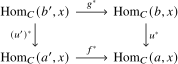 proving that \(u'\) is an \(S\)-equivalence whenever \(u\) has this property.
From Section 18.1, Compactly generated left Bousfield localizations.