Definition 17.4.1. Let \(x\) and \(y\) be two objects of a category \(C\). Recall that we say that \(x\) is a retract of \(y\) if there is a morphism of the form \(q\colon y\to x\) that admits a section.
A projector is a morphism of the form \(p\colon y\to y\) for some object \(y\) in a category \(C\) equipped with an identification \(\pi\colon p = p^2\). We say that such a projector has an image if there exists an object \(x\) together with morphisms \(q\colon y\to x\) and \(s\colon x\to y\) such that \(s\) is a section of \(q\), \(p = s\circ q\) and \(\pi\colon p = p^2\) is isomorphic to the identification coming from \begin{align*} p&=s\circ q\\ &=s\circ \id_x\circ q\\ &=s\circ q\circ s\circ q\\ &=p\circ p\, . \end{align*}
Lemma 17.4.2. If \(C\) is a category with \(\omega\)-indexed colimits, then any projector has an image in \(C\).
Proof
Let \(p\colon y\to y\) be a projector.
We denote by \(Y\) the \(\omega\)-indexed diagram corresponding to the sequence
\[
y\xrightarrow{\id_y}y\xrightarrow{\id_y}y\to\cdots\to y\xrightarrow{\id_y}y\xrightarrow{\id_y}y\to\cdots
\]
We then define an \(\omega\)-indexed diagram \(X\) by forming the sequence of morphisms below.
\[
y\xrightarrow{p}y\xrightarrow{p}y\to\cdots\to y\xrightarrow{p}y\xrightarrow{p}y\to\cdots
\]
We clearly have
\[
y=\underset{\omega}{\colim}\, Y
\]
and we define
\[
x:=\underset{\omega}{\colim}\, X\, .
\]
The sequence of commutative squares
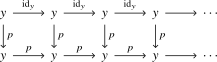 defines a map \(Q\colon Y\to X\)
and similarly,
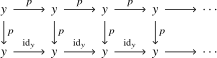 defines a map \(S\colon X\to Y\). This yields two maps
\[
q\colon y\to x\quad\text{and}\quad s\colon x\to y
\]
by passing to colimits. It remains to prove that \(s\) is a section of \(q\).
The composition \(q\circ s\) is obtained from \(Q\circ S\) by taking the colimit.
But \(Q\circ S\) simply is the sequence of maps
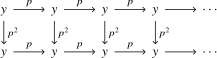 and \(\pi\colon p = p^2\) yields an isomorphism from \(Q\circ S\) to the sequence of maps
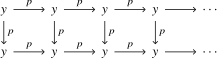 But the colimit of the latter sequence clearly is the identity of \(x\), since
\(\omega_{1/}\to\omega\) is a terminal functor.
Lemma 17.4.3. Let \(C\) be a category and \(q\colon y\to x\) a map in \(C\) equipped with a section \(s\colon x\to y\). If we define \(p:=s\circ q\), then \(x\) canonically is the colimit of the diagram \[ y\xrightarrow{p}y\xrightarrow{p}y\to\cdots\to y\xrightarrow{p}y\xrightarrow{p}y\to\cdots \]
Proof
We may assume that \(C\) is small. It suffices to prove the lemma for the image of the diagram
through the Yoneda embedding of \(C\): since the Yoneda embedding is fully faithful,
if an object of \(C\) happens to be a colimit in \(\PSh(C)\) of a diagram
taking values in \(C\), it must be a colimit in \(C\) as well.
Therefore, we may assume that \(C\) has \(\omega\)-indexed colimits.
Let \(x'\) be the colimit of the diagram as stated in the lemma.
The sequence of commutative squares defined by \(q\circ p=q\circ s\circ q=q\)
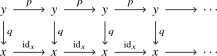 induces a map \(u\colon x'\to x\). Similarly, the sequence of commutative squares
associated to the relation \(p\circ s=s\circ q\circ s=s\)
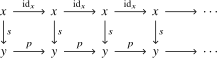 induces a map \(v\colon x\to x'\). It is clear that \(u\circ v=\id_{x}\) by functoriality,
since \(q\circ s=\id_x\).
Finally, the composition \(v\circ u\) is the colimit of the diagram
that is the identity of \(x'\), by a cofinality argument as at the end of the proof
of Lemma 17.4.2.
Proposition 17.4.4. Let \(\kappa\hookrightarrow\Cat\) be a small subuniverse. We consider a small category with \(\kappa\)-small colimits. Any retract of a representable presheaf on \(C\) is a \(\kappa\)-compact object in \(\Ind_\kappa(C)\). Conversely, the collection of retracts of representable presheaves covers the collection of \(\kappa\)-compact objects in \(\Ind_\kappa(C)\).
Proof
Let \(y\) be an object of \(C\) and \(q\colon\Hom_C(-,y)\to F\) a map in \(\PSh(C)\)
equipped with a section \(s\colon F\to\Hom_C(-,y)\).
The the property of comuting with \(\kappa\)-small limits is stable under retracts so that \(F\)
belongs to \(\Ind_\kappa(C)\). We already know that the property of being \(\kappa\)-compact
is stable under retracts.
Conversely, let \(F\) be a compact object of \(\Ind_\kappa(C)\). There
is a small \(\kappa\)-filtered category \(I\), a functor \(\varphi\colon I\to C\)
and an isomorphism of the form
\[
\underset{i\colon I}{\colim}\, h_C(\varphi(i)) = F\, .
\]
Since \(F\) is \(\kappa\)-compact, we have an equivalence:
\[
\underset{i\colon I}{\colim}\, \Hom(F,h_C(\varphi(i)))\simeq\Hom(F,F)\, .
\]
Since we have a canonical cover of the form
\[
\underset{i\colon I^\simeq}{\sum}\, \Hom(F,h_C(\varphi(i)))
\to \underset{i\colon I}{\colim}\, \Hom(F,h_C(\varphi(i)))
\]
this means that there exists \(i\colon I^\simeq\) and a map \(q\colon F\to h_C(\varphi(i))\)
such that its composition with the structural map
\[
h_C(\varphi(i))\to \underset{i\colon I}{\colim}\, h_C(\varphi(i))\iso F
\]
is the identity of \(F\).
Corollary 17.4.5. Let \(\kappa\hookrightarrow\Cat\) be a small subuniverse and \(D\) be \(\kappa\)-presentable category. Then the full subcategory \(D^\kappa\) of \(\kappa\)-compact objects of \(D\) is small.
Proof
By virtue of Theorem 17.2.24, we may assume that \(D=\Ind_\kappa(C)\) for some small category \(C\) with \(\kappa\)-small colimits. Since the collection of retracts of representable presheaves forms a small family, we conclude with Proposition 17.4.4 and Proposition 11.2.18.
Definition 17.4.6. A category \(C\) is called idempotent complete if any projector in \(C\) has an image.
Proposition 17.4.7. Let \(\kappa\hookrightarrow\Cat\) be a small subuniverse. A small category with \(\kappa\)-small colimits \(C\) is idempotent complete if and only if any \(\kappa\)-compact object of \(\Ind_\kappa(C)\) is representable.
Proof
If \(C\) is idempotent complete, then it follows from Proposition 17.4.4 that any \(\kappa\)-compact object of \(\Ind_\kappa(C)\) is representable. Conversely, any projector in \(C\) has an image in \(\Ind_\kappa(C)\) by Lemma 17.4.2, and such an image will be a \(\kappa\)-compact object of \(\Ind_\kappa(C)\) by Proposition 17.4.4. Therefore, if any \(\kappa\)-compact object of \(\Ind_\kappa(C)\) is representable, any projector of \(C\) has an image in \(C\).
Definition 17.4.8. Let \(\kappa\hookrightarrow\Cat\) be a small subuniverse. Let us choose a universe of large categories \(\Cat'\) (so that \(\Cat\) is both an object and a full subcategory of \(\Cat'\)). We define \(\PrL_\kappa\) as the subcategory of \(\Cat'\) whose objects are the \(\kappa\)-presentable categories and whose morphisms are the functors that commute with small colimits and that preserve \(\kappa\)-compact objects.
Given \(A\) and \(B\) two \(\kappa\)-presentable categories, we denote by \(\FunL_\kappa(A,B)\) the full subcategory of \(\Fun(A,B)\) spanned by the functors that preserve small colimits as well as \(\kappa\)-compact objects. In particular, we have: \[ \Hom_{\PrL_\kappa}(A,B)=\FunL_\kappa(A,B)^\simeq\, . \]
Theorem 17.4.9. Let \(\kappa\hookrightarrow\Cat\) be a small subuniverse. Given a small category with \(\kappa\)-small colimits \(C\) and a \(\kappa\)-presentable category \(D\), there is a canonical equivalence of categories of the form \[ \Rex(C,D^\kappa)\simeq\FunL_\kappa(\Ind(C),D)\, . \] In particular, assigning the full subcategory of \(\kappa\)-compact objects defines a fully faithful functor \[ \PrL_\kappa\to\RexCat^\kappa\ , \quad D\mapsto D^\kappa \] that is right adjoint to the functor \[ \Ind_\kappa\colon\RexCat\to\PrL_\kappa\ , \quad C\mapsto\Ind_\kappa(C)\, . \]
Proof
Corollary 17.4.5
and Theorem 17.2.24
ensure that
\[
\Ind_\kappa(D^\kappa)=D\, .
\]
By definition, there is pullback square of the form
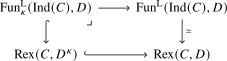 in which, by virtue of Proposition 17.3.8,
the vertical arrow on the right side
is an equivalence. This proves the first assertion of the theorem.
The second one follows from the first by applying the operator \((-)^\simeq\).
Corollary 17.4.10. For any small subuniverse \(\kappa\hookrightarrow\Cat\), the category \(\PrL_\kappa\) is locally small and has small limits. If furthermore the subuniverse \(\kappa\) is localizing (e.g. if it is elementary) then \(\PrL_\kappa\) has small colimits as well.
Proof
We know that \(\RexCat_\kappa\) has small limits by Lemma 17.3.2 and that, if \(\kappa\) is furthermore localizing, it also has small colimits by Proposition 17.3.8. Since \(\PrL_\kappa\) is a full subcategory of \(\RexCat_\kappa\) through a right adjoint, all kinds of (co-)limits that exist in \(\RexCat_\kappa\) also exist in \(\PrL_\kappa\) by Corollary 14.2.5.
Lemma 17.4.11. If the subuniverse \(\kappa\) is elementary, then the full embedding \(\PrL_\kappa\hookrightarrow\RexCat^\kappa\) commutes with small \(\kappa\)-filtered colimits.
Proof
Let \(I\) be a small \(\kappa\)-filtered category and \(D\colon I\to\PrL_\kappa\) a functor. We define \[ C:=\underset{i\colon I}{\colim}\, D(i)^\kappa\, . \] For any \(\kappa\)-compactly generated category \(E\) we have: \begin{align*} \FunL(\Ind_\kappa(C),E) &=\Rex^\kappa(C,E)\\ &=\Rex^\kappa(\underset{i\colon I}{\colim}\, D(i)^\kappa,E)\\ &=\underset{i\colon I\catop}{\lim}\, \Rex(D(i)^\kappa,E)\\ &=\underset{i\colon I\catop}{\lim}\, \FunL(D(i),E) \end{align*} obviously inducing an equivalence \[ \FunL_\kappa(\Ind(C),E)\simeq\underset{i\colon I\catop}{\lim}\, \FunL_\kappa(D(i),E) \] In particular, the colimit of \(i\mapsto D(i)\) in \(\PrL_\kappa\) simply is \(\Ind_\kappa(C)\). The lemma thus simply means that \(C\) is idempotent complete by Proposition 17.4.7. But, using that \([2]\) is compact in \(\Cat\), since \(I\) is filtered, we see that the collection of projectors in \(C\) is the colimit of the diagram assigning to each \(i\colon I\) the collection of projectors in \(D(i)\). The fact that each projector has an image in each \(D(i)\) thus implies that each projector in \(C\) has an image in \(C\) as well.
Theorem 17.4.12. If the subuniverse \(\kappa\) is localizing (e.g. if it is elementary), then the category \(\PrL_\kappa\) is \(\kappa\)-presentable: \[ \PrL_\kappa\colon(\PrL_\kappa)^\simeq\, . \]
Proof
The preceding lemma allows us to apply Proposition 18.3.12.
Remark 17.4.13. The functor \(C\mapsto\Ind_\kappa(C)\) restricts to an equivalence from the full subcategory of \(\RexCat^\kappa\) spanned by small idempotent complete categories with \(\kappa\)-small colimits to \(\PrL_\kappa\): this is what the combination of Theorem 18.6.10 and of Proposition 17.4.7 means. In other words, for any small category with \(\kappa\)-small colimits \(C\), the Yoneda embedding induces a fully faithful right exact functor \(C\hookrightarrow\Ind_\kappa(C)^\kappa\) that is the universal \(\kappa\)-small colimits preserving functor from \(C\) to a small idempotent complete category with \(\kappa\)-small colimits. We call \(\Ind_\kappa(C)^\kappa\) the idempotent completion of \(C\).