Lemma 17.4.2. If \(C\) is a category with \(\omega\)-indexed colimits, then any projector has an image in \(C\).
Proof
Let \(p\colon y\to y\) be a projector.
We denote by \(Y\) the \(\omega\)-indexed diagram corresponding to the sequence
\[
y\xrightarrow{\id_y}y\xrightarrow{\id_y}y\to\cdots\to y\xrightarrow{\id_y}y\xrightarrow{\id_y}y\to\cdots
\]
We then define an \(\omega\)-indexed diagram \(X\) by forming the sequence of morphisms below.
\[
y\xrightarrow{p}y\xrightarrow{p}y\to\cdots\to y\xrightarrow{p}y\xrightarrow{p}y\to\cdots
\]
We clearly have
\[
y=\underset{\omega}{\colim}\, Y
\]
and we define
\[
x:=\underset{\omega}{\colim}\, X\, .
\]
The sequence of commutative squares
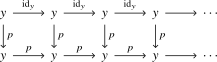 defines a map \(Q\colon Y\to X\)
and similarly,
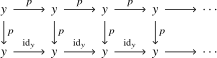 defines a map \(S\colon X\to Y\). This yields two maps
\[
q\colon y\to x\quad\text{and}\quad s\colon x\to y
\]
by passing to colimits. It remains to prove that \(s\) is a section of \(q\).
The composition \(q\circ s\) is obtained from \(Q\circ S\) by taking the colimit.
But \(Q\circ S\) simply is the sequence of maps
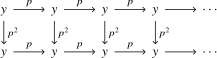 and \(\pi\colon p = p^2\) yields an isomorphism from \(Q\circ S\) to the sequence of maps
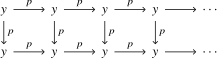 But the colimit of the latter sequence clearly is the identity of \(x\), since
\(\omega_{1/}\to\omega\) is a terminal functor.