We fix once and for all in this section a small subuniverse \(\kappa\hookrightarrow\Cat^\simeq\).
Notation 17.3.1. We denote by \(\RexCat^\kappa\) the subcategory of \(\Cat\) with morphisms the functors between small categories with \(\kappa\)-small colimits that commute with \(\kappa\)-small colimits. Given two small categories with \(\kappa\)-small colimits \(A\) and \(B\), we write \(\Rex^\kappa(A,B)\) for the full subcategory of \(\Fun(A,B)\) spanned by functors that commute with \(\kappa\)-small colimits.
Recall from Construction 17.2.25 that we can assign to each small category \(C\) a small category \(\langle C\rangle_\kappa\) with \(\kappa\)-small colimits equipped with a canonical fully faithful functor \[ h\colon C\to \langle C\rangle_\kappa\, . \]
It is an easy exercise to prove the following lemma using Proposition 13.2.14.
Lemma 17.3.2. The category \(\RexCat_\kappa\) has small limits and the embedding \(\RexCat_\kappa\hookrightarrow\Cat\) commutes with them.
Theorem 17.3.3. Given a small category \(C\) and and a category \(D\) with \(\kappa\)-small colimits, the functor \(h\colon C\to \langle C\rangle_\kappa\) induces an equivalence of categories of the form \[ \Rex^\kappa(\langle C\rangle_\kappa,D)=\Fun(C,D)\, . \] In particular, the embedding \[ \RexCat^\kappa\hookrightarrow\Cat \] has a left adjoint given objectwise by \(C\mapsto \langle C\rangle_\kappa\).
Proof
Up to enlarging the universe, we may assume that \(D\) is small as well. We will now prove the theorem under this extra assumption. It suffices to prove that \(h\) induces an equivalence of the form \[ \Map(A,\Rex^\kappa(\langle C\rangle_\kappa,D))=\Map(A,\Fun(C,D)) \] for all \(A\) and \(D\) (we can even restrict to the case \(A=[1]\)). Since we have \[ \Map(A,\Rex^\kappa(\langle C\rangle_\kappa,D))=\Rex^\kappa(\langle C\rangle_\kappa,\Fun(A,D))^\simeq \] and \[ \Map(A,\Fun(C,D))=\Fun(C,\Fun(A,D))^\simeq \] it suffices to prove that \(h\) induces an equivalence of the form \[ \Rex^\kappa(\langle C\rangle_\kappa,D)^\simeq=\Fun(C,D)^\simeq\, . \] Since \(\Ind_\kappa(D)\) has small colimits and is locally small the Yoneda embedding \[ h\colon C\to\PSh(C) \] induces an equivalence of the form \[ \FunL(\PSh(C),\Ind_\kappa(D))=\Fun(C,\Ind_\kappa(D))\, . \] We can thus identify \(\Fun(C,D)\) with the full subcategory of \(\FunL(\PSh(C),\Ind_\kappa(D))\) spanned by those small colimits preserving functors that preserve representable presheaves. Furthermore, we have a canonical equivalence \[ \Ind_\kappa(\langle C\rangle_\kappa))=\PSh(C)\, . \] Therefore, each functor \(\varphi\colon\langle C\rangle_\kappa\to D\) that preserves \(\kappa\)-small colimits will induce by Proposition 17.2.21 a left adjoint \[ \varphi_!\colon\FunL(\Ind_\kappa(\langle C\rangle_\kappa)),\Ind_\kappa(D)) \] that is totally determined by its restriction to \(C\). More precisely, since \[ \Ind_\kappa(\Iso(D))=\Iso(\Ind_\kappa(D)) \] we see that for two functor \[ \varphi,\varphi'\colon\langle C\rangle_\kappa\to D \] there is a canonical equivalence of the form \[ (\varphi=\varphi')\iso(\varphi_!=\varphi^\prime_!) \, . \] This shows that composing with \(h\) induces a map \[ \Rex^\kappa(\langle C\rangle_\kappa,D)^\simeq\to\Fun(C,D)^\simeq \] that is an embedding. It suffices now to check that it has a section. If we start from a functor \(\psi\colon C\to D\), we may consider the small colimits preserving functor \[ \psi_!\colon \PSh(C)\to \Ind_\kappa(D) \] associated to \[ C\xrightarrow{\psi}D\hookrightarrow\Ind_\kappa(D)\, . \] We observe that the restriction of \(\psi_!\) to \(\langle C\rangle_\kappa\) takes its values in representable presheaves on \(D\): since \(D\) is stable under \(\kappa\)-small colimits in \(\Ind_\kappa(D)\), the full subcategory of \(\PSh(C)\) spanned by those presheaves whose image through \(\psi_!\) is in \(D\) is stable by \(\kappa\)-small colimits and contains representable presheaves on \(C\). The restriction of \(\psi_!\) to \(\langle C\rangle_\kappa\) thus yields a functor \[ \varphi\colon\langle C\rangle_\kappa\to D \] such that \(\varphi\circ h=\psi\).
Lemma 17.3.4. We consider given a small category with \(\kappa\)-small colimits and a family of maps \(W\hookrightarrow\Map([1],C)\), with \(\gamma\colon C\to L(C)\) the associated localization functor. We assume furthermore that \(\gamma\) has a right adjoint. If \(D\) is an other category with \(\kappa\)-small colimits, a functor \(f\colon L(C)\to D\) commutes with \(\kappa\)-small colimits if and only if \(f\circ\gamma\colon C\to D\) has the same property.
Proof
Since the right adjoint \(\delta\) of \(\gamma\) is fully faithful, we know that \(L(C)\) has \(\kappa\)-small colimits and that they are computed by applying the right adjoint of \(\gamma\), taking the colimit in \(C\), and then applying \(\gamma\) to the result. This implies right away that, if \(f\) commutes with \(\kappa\)-small colimits, so does \(f\circ \gamma\). Conversely, if \(f\circ \gamma\) preserves colimit cocones indexed by \(\kappa\)-small categories, given any \(\kappa\)-small category \(I\) and any \(I\)-indexed functor \(i\mapsto x_i\) with values in \(C\), we have \begin{align*} {\colim}\, f(x_i) &={\colim}\, (f\circ\gamma)(\delta(x_i))\\ &=(f\circ\gamma)({\colim}\,\delta(x_i))\\ &=f(\gamma({\colim}\,\delta(x_i)))\\ &=f({\colim}\, \gamma(\delta(x_i)))\\ &=f({\colim}\, x_i)\, . \end{align*} Therefore, the functor \(f\) commutes with \(\kappa\)-small colimits.
Proposition 17.3.5. Given any small category with \(\kappa\)-small colimits \(C\), given a \(\kappa\)-presentable category \(D\), the Yoneda embedding \[ h\colon C\hookrightarrow\Ind_\kappa(C) \] induces an equivalence of the form \[ \FunL(\Ind_\kappa(C),D)\simeq\RexCat_\kappa(C,D)\, . \]
Proof
Let \(\gamma\colon\langle C\rangle_\kappa\to C\) be the \(\kappa\)-small colimits preserving functor
asociated to the identity of \(C\) (left adjoint to the Yoneda embedding of \(C\)
into \(\langle C\rangle_\kappa\)). The Yoneda embedding of \(C\)
induces an equivalence
\[
\FunL(\PSh(C),D)\simeq\Fun(C,D)\, .
\]
Using the equivalence
\[
\PSh(C)=\Ind_\kappa(\langle C\rangle_\kappa)\, ,
\]
it than can be recasted as an equivalence of the form
\[
\FunL(\Ind_\kappa(\langle C\rangle_\kappa),D)\simeq\RexCat_\kappa(\langle C\rangle_\kappa,D)
\]
by Theorem 17.3.3.
On the other hand, there is
a canonical commutative square of the form
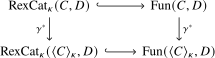 in which the two horizontal functors as well as
the vertical one on the right are fully faithful, thus proving that the one on the left
is fully faithful as well. This means that Lemma 17.3.4
may be reinterpreted by saying that the commutative square above is cartesian.
Let
\[
\gamma_!\colon\Ind_\kappa(\langle C\rangle_\kappa)\to\Ind_\kappa(C)
\]
be the left Kan extension of \(\gamma\) (left adjoint of the full embedding \(\gamma^*\) of \(\Ind_\kappa(C)\)
into \(\PSh(C)\)). Precomposing with the localization \(\gamma_!\) induces a fully faithful functor
\[
\Fun(\Ind_\kappa(C),D)\hookrightarrow\Fun(\Ind_\kappa(\langle C\rangle_\kappa),D)
\]
and thus a fully faithful functor of the form
\[
\FunL(\Ind_\kappa(C),D)\hookrightarrow\FunL(\Ind_\kappa(\langle C\rangle_\kappa),D)\, .
\]
The discussion above tells us in particular that the functor
\[
h^*\colon \FunL(\Ind_\kappa(C),D)\to\RexCat_\kappa(C,D)
\]
is fully faithful, so that it only remains to prove its essential surjectivity.
Let \(\varphi\colon C\to D\) be a functor that preserves \(\kappa\)-small colimits.
We get an adjunction
\[
\varphi_!\colon\PSh(C)\rightleftarrows D\colon\varphi^*\, .
\]
For any object \(y\) of \(D\), the functor
\[
\varphi^*(y)=\Hom_D(-,y)
\]
preserves \(\kappa\)-small limits and thus belongs to \(\Ind_\kappa(C)\) by
Corollary 17.2.35.
In other words, we have a unit-isomorphism of the form
\[
\varphi^*=\gamma^*\, \gamma_!\, \varphi^*\, .
\]
Equivalently, for any presheaf \(F\colon C\catop\to\An\),
the unit \(\eta_F\colon F\to \gamma^*\, \gamma_!(F)\)
induces an isomorphism of the form
\[
\Hom(\gamma^*\, \gamma_!(F),\varphi^*(y))=\Hom(F,\varphi^*(y))\, .
\]
Let us consider the functor
\[
\Phi\colon\Ind_\kappa(C)\to D
\]
defined as \(\Phi(F)=\varphi_!(\gamma^*(F))\).
We observe that \(\Phi\) is right adjoint to the functor
\[
\Psi\colon D\to\Ind_\kappa(C)
\]
defined through \(\gamma^*\Psi(y)=\varphi^*(y)\). It is clear that \(\Phi\circ h=\varphi\)
by construction.
Lemma 17.3.6. Let us assume that the subuniverse \(\kappa\) is localizing. We consider given a small category with \(\kappa\)-small colimits and a family of maps \(W\hookrightarrow\Map([1],C)\) stable under \(\kappa\)-small colimits, with \(\gamma\colon C\to L(C)\) the associated localization functor. If \(D\) is an other category with \(\kappa\)-small colimits, a functor \(f\colon L(C)\to D\) commutes with \(\kappa\)-small colimits if and only if \(f\circ\gamma\colon C\to D\) has the same property.
Proof
We will use Proposition 17.2.13. Let \(K\) be a strictly \(\kappa\)-small category. The equivalence \[ L(\Fun(K,C))=\Fun(K,L(C)) \] yields a cover of the form \[ \Fun(K,C)^\simeq\to\Fun(K,L(C))^\simeq\, . \] Since the localization functor \(\gamma\colon C\to L(C)\) commutes with strictly \(\kappa\)-small colimits, this implies that \(f\) commutes with strictly \(\kappa\)-small colimits if and only if \(f\circ\gamma\) has the same property.
Corollary 17.3.7 (Right exact functors out of a localization). Let \(C\) and \(L\) be small categories with finite colimits, and let \(\gamma\colon C\to L\) be a right exact localization at a family of morphisms \(W\). For every category \(D\) with finite colimits, precomposition with \(\gamma\) induces an equivalence \[ \Rex(L,D)\simeq\Rex^W(C,D), \] where \(\Rex^W(C,D)\) is the full subcategory of \(\Rex(C,D)\) spanned by the functors sending every morphism in \(W\) to an isomorphism. Dually, for a left exact localization between small categories with finite limits, the corresponding assertion holds for left exact functors into any category with finite limits.
Proof
The family of all morphisms inverted by \(\gamma\) is closed under finite colimits in \(\Fun([1],C)\), since \(\gamma\) is right exact, and defines the same localization as \(W\). The finite posets form a localizing subuniverse by Example 17.2.12 and Corollary 17.2.14. Applying Lemma 17.3.6 to this family shows that a functor \(f\colon L\to D\) is right exact if and only if \(f\gamma\) is right exact. Thus the universal property of localization restricts to the displayed equivalence. The left exact version follows by passing to opposite categories.
Proposition 17.3.8. If the small subuniverse \(\kappa\) is localizing then \(\RexCat_\kappa\) has small colimits.
Proof
Given small categories with \(\kappa\)-small colimits \(A\) and \(B\) and a family \(W\) of maps in \(A\),
we denote by \(\RexCat^\kappa_W(A,B)\) the full subcategory of \(\RexCat_\kappa(A,B)\) spanned by those functors
that send maps in \(W\) to isomorphisms of \(B\).
Let \(I\) be a small category and
\[
i\mapsto C_i
\]
an \(I\)-indexed diagram with values in \(\RexCat_\kappa\).
We let \(C'\) be the colimit of the aforementioned diagram in \(\Cat\).
Since left adjoints preserve colimits, we have
\[
\underset{i\colon I}{\colim}\, \langle C_i\rangle_\kappa=\langle C'\rangle_\kappa
\]
in \(\RexCat_\kappa\).
For each \(i\colon I^\simeq\), the canonical full embedding \(C_i\hookrightarrow\langle C_i\rangle_\kappa\)
has a left adjoint \(\gamma_i\colon \langle C_i\rangle_\kappa\to C_i\). We denote by \(W_i\)
the family of maps in \(\langle C_i\rangle_\kappa\) that become invertible after applying \(\gamma_i\).
We denote by \(W'_i\) the image of \(W_i\) through the canonical functor
\[
\mathit{can}_i\colon \langle C_i\rangle_\kappa\to \langle C'\rangle_\kappa\, .
\]
We define \(W\) as the union of all the \(W'_i\)’s, and \(\bar{W}\) as the closure of \(W\) under \(\kappa\)-small
colimits. We define finally \(C\) as the localization of \(\langle C'\rangle_\kappa\) by \(\bar{W}\).
Given a small category \(D\) with \(\kappa\)-small colimits, the functor \(\gamma_i\) being a localization with a right adjoint, Lemma 17.3.4 implies that we have a canonical equivalence of the form \[ \gamma^*_i\colon\Rex^\kappa(C_i,D)\iso \Rex_{W_i}^\kappa(\langle C_i\rangle_\kappa,D) \] for all \(i\colon I^\simeq\). We also observe that the equivalence \[ \Rex^\kappa(\langle C'\rangle_\kappa,D)^\simeq= \underset{i\colon I\catop}{\lim}\, \Rex^\kappa(\langle C_i\rangle_\kappa,D)^\simeq \] restricts to an equivalence of the form \[ \Rex^\kappa_{W}(\langle C'\rangle_\kappa,D)^\simeq= \underset{i\colon I\catop}{\lim}\, \Rex^\kappa_{W_i}(\langle C_i\rangle_\kappa,D)^\simeq\, . \] Using Lemma 17.3.6 for the first line, this yields the following identifications \begin{align*} \Rex^\kappa(C,D)^\simeq &=\Rex^\kappa_{\bar{W}}( \langle C'\rangle_\kappa,D)^\simeq\\ &=\Rex^\kappa_W( \langle C'\rangle_\kappa,D)^\simeq\\ &=\underset{i\colon I\catop}{\lim}\, \Rex_{W_i}^\kappa(\langle C_i\rangle_\kappa,D)^\simeq\\ &=\underset{i\colon I\catop}{\lim}\, \Rex^\kappa(C_i,D)^\simeq \end{align*} thus proving that \(C\) it the colimit of \(i\mapsto C_i\) in \(\RexCat_\kappa\).
Proposition 17.3.9. If \(\kappa\) is elementary then \(\kappa\)-small categories are stable under binary products in \(\Cat\).
Proof
Since \([1]\times [1]\) is a pushout of a diagram of the form \[ [2]\leftarrow [1]\to [2]\, , \] and since \([n]\) is \(\kappa\)-small for any \(n\colon\N\), the product \([1]\times [1]\) is \(\kappa\)-small. Since the functor \((-)\times [1]\) commutes with pushouts, one deduces that \([m]\times [1]\) is \(\kappa\)-small by induction on \(m\colon\N\). Similarly, one deduces then that \([m]\times [n]\) is \(\kappa\)-small for all \(m,n\colon\N\). The category of those small categories \(A\) such that \(A\times [n]\) is \(\kappa\)-small for all \(n\) is stable under \(\kappa\)-small colimits and contains \([m]\) for all \(m\). therefore, \(A\times [n]\) is \(\kappa\)-small for all \(A\) \(\kappa\)-small and all \(n\colon\N\). A similar argument shows that \(A\times B\) is \(\kappa\)-small for any \(A\) and \(B\) \(\kappa\)-small.
Corollary 17.3.10. If \(\kappa\) is elementary, then \(\kappa\)-small categories are \(\kappa\)-compact in \(\Cat\) and, for any \(\kappa\)-small category \(A\), the functor \[ \Fun(A,-)\colon\Cat\to\Cat \] commutes with small \(\kappa\)-filtered colimits.
Proof
Since \(\pushout\) is \(\kappa\)-compact in \(\Cat\) and since \(\kappa\)-compact objects are stable under retracts, we know that \([n]\) is \(\kappa\)-compact for \(n=0\) and \(n=1\). Since \(\kappa\)-compact objects are stable under \(\kappa\)-small colimits, they are in particular stable under pushouts, so that \([n]\) is compact for all \(n\). This implies that \(\kappa\)-small categories are \(\kappa\)-compact in \(\Cat\). If \(A\) is a \(\kappa\)-compact category, then, in order to prove that \(\Fun(A,-)\) commutes with small \(\kappa\)-filtered colimits, it suffices to check that the functor \[ \Map([1],\Fun(A,-))=\Map([1]\times A,-) \] commutes with small \(\kappa\)-filtered colimits. In other words, it suffices to know that \([1]\times A\) is \(\kappa\)-compact in \(\Cat\). Since it is \(\kappa\)-small by the preceding proposition, this achieves the proof.
Corollary 17.3.11. If \(\kappa\) is elementary, the property of having a right (left) adjoint is stable under \(\kappa\)-small colimits in \(\Fun([1],\Cat)\).
Proof
Since \(A\mapsto A\catop\) commute with \(\kappa\)-small colimits (being an equivalence), it suffices to ficus on the property of having a right adjoint section. But the functor \(\Fun([1],-)\) commutes with \(\kappa\)-filtered colimits by the previous corollary and \(\kappa\)-filtered categories are distilled (since \(\kappa\) is elementary), so that \(\kappa\)-filtered colimits of categories commute with pullbacks (using the fact that the Rezk nerve is fully faithful and has a left adjoint, it suffices to prove that distilled colimits commute with pullbacks in \(\PSh(\Delta)\)). This implies right away that the property of having a right adjoint section is compatible with the formation of \(\kappa\)-filtered colimits.
Corollary 17.3.12. If the small subuniverse \(\kappa\) is elementary then \(\RexCat_\kappa\) is \(\kappa\)-presentable. Furthermore, the forgetful functor \[ \RexCat_\kappa\hookrightarrow\Cat \] commutes with small \(\kappa\)-filtered colimits.
Proof
The forgetful functor \(\RexCat_\kappa\hookrightarrow\Cat\) is conservative so that
Theorem 17.3.3 implies that
\(\langle [1]\rangle_\kappa\) is a generator of \(\RexCat_\kappa\).
Since \([1]\) is \(\kappa\)-compact in \(\Cat\), it suffices to prove that
the forgetful functor
\[
\RexCat_\kappa\hookrightarrow\Cat
\]
commutes with small \(\kappa\)-filtered colimits.
Let \(I\) be a small \(\kappa\)-filtered category and \(i\mapsto C_i\) an \(I\)-indexed
diagram with values in \(\RexCat_\kappa\). We denote by \(C\) the colimit of this diagram in \(\Cat\).
For any \(\kappa\)-small
category \(A\), we have by Corollary 17.3.10
\[
\underset{i\colon I}{\colim}\, \Fun(A,C_i)=\Fun(A,C)\, .
\]
Therefore, it follows right away from Corollary 17.3.11
that \(C\) has \(\kappa\)-small colimits.
If \(D\) is any small category with \(\kappa\)-small colimits, and if \(f\colon C\to D\)
is a functor such that
\[
f_i\colon C_i\xrightarrow{\mathit{can}_i}C\xrightarrow{f}D
\]
commutes with \(\kappa\)-small colimits for all \(i\colon I^\simeq\),
we then have commutative squares of the form
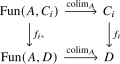 forming an \(I\)-indexed cocone in \(\Fun([1],\Cat)\)
hence yielding a commutative square of the form
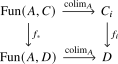 thus proving that \(f\) commutes with \(\kappa\)-small colimits.