Proposition 17.3.5. Given any small category with \(\kappa\)-small colimits \(C\), given a \(\kappa\)-presentable category \(D\), the Yoneda embedding \[ h\colon C\hookrightarrow\Ind_\kappa(C) \] induces an equivalence of the form \[ \FunL(\Ind_\kappa(C),D)\simeq\RexCat_\kappa(C,D)\, . \]
Proof
Let \(\gamma\colon\langle C\rangle_\kappa\to C\) be the \(\kappa\)-small colimits preserving functor
asociated to the identity of \(C\) (left adjoint to the Yoneda embedding of \(C\)
into \(\langle C\rangle_\kappa\)). The Yoneda embedding of \(C\)
induces an equivalence
\[
\FunL(\PSh(C),D)\simeq\Fun(C,D)\, .
\]
Using the equivalence
\[
\PSh(C)=\Ind_\kappa(\langle C\rangle_\kappa)\, ,
\]
it than can be recasted as an equivalence of the form
\[
\FunL(\Ind_\kappa(\langle C\rangle_\kappa),D)\simeq\RexCat_\kappa(\langle C\rangle_\kappa,D)
\]
by Theorem 17.3.3.
On the other hand, there is
a canonical commutative square of the form
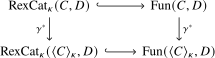 in which the two horizontal functors as well as
the vertical one on the right are fully faithful, thus proving that the one on the left
is fully faithful as well. This means that Lemma 17.3.4
may be reinterpreted by saying that the commutative square above is cartesian.
Let
\[
\gamma_!\colon\Ind_\kappa(\langle C\rangle_\kappa)\to\Ind_\kappa(C)
\]
be the left Kan extension of \(\gamma\) (left adjoint of the full embedding \(\gamma^*\) of \(\Ind_\kappa(C)\)
into \(\PSh(C)\)). Precomposing with the localization \(\gamma_!\) induces a fully faithful functor
\[
\Fun(\Ind_\kappa(C),D)\hookrightarrow\Fun(\Ind_\kappa(\langle C\rangle_\kappa),D)
\]
and thus a fully faithful functor of the form
\[
\FunL(\Ind_\kappa(C),D)\hookrightarrow\FunL(\Ind_\kappa(\langle C\rangle_\kappa),D)\, .
\]
The discussion above tells us in particular that the functor
\[
h^*\colon \FunL(\Ind_\kappa(C),D)\to\RexCat_\kappa(C,D)
\]
is fully faithful, so that it only remains to prove its essential surjectivity.
Let \(\varphi\colon C\to D\) be a functor that preserves \(\kappa\)-small colimits.
We get an adjunction
\[
\varphi_!\colon\PSh(C)\rightleftarrows D\colon\varphi^*\, .
\]
For any object \(y\) of \(D\), the functor
\[
\varphi^*(y)=\Hom_D(-,y)
\]
preserves \(\kappa\)-small limits and thus belongs to \(\Ind_\kappa(C)\) by
Corollary 17.2.35.
In other words, we have a unit-isomorphism of the form
\[
\varphi^*=\gamma^*\, \gamma_!\, \varphi^*\, .
\]
Equivalently, for any presheaf \(F\colon C\catop\to\An\),
the unit \(\eta_F\colon F\to \gamma^*\, \gamma_!(F)\)
induces an isomorphism of the form
\[
\Hom(\gamma^*\, \gamma_!(F),\varphi^*(y))=\Hom(F,\varphi^*(y))\, .
\]
Let us consider the functor
\[
\Phi\colon\Ind_\kappa(C)\to D
\]
defined as \(\Phi(F)=\varphi_!(\gamma^*(F))\).
We observe that \(\Phi\) is right adjoint to the functor
\[
\Psi\colon D\to\Ind_\kappa(C)
\]
defined through \(\gamma^*\Psi(y)=\varphi^*(y)\). It is clear that \(\Phi\circ h=\varphi\)
by construction.
From Section 17.3, Presentable categories with respect to a subuniverse.