Proposition 11.2.18 (Non-axiom of replacement). Let \(C\) be a locally small category and \(\Gamma\) a small anima. We consider a functor \(f\colon\Gamma\to C^\simeq\). Then \(\Im(f)\) is small. In particular, the full subcategory of \(C\) with anima of objects \(\Im(f)\) is small.
Proof
For any \(x,y : C^\simeq\), we have an embedding
\[
C^\simeq(x,y)\hookrightarrow C(x,y)
\]
with small codomain. Therefore, the anima \(C^\simeq\) is locally small.
In other words, there is a pullback square of the form
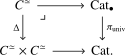 Since cocartesian fibrations with small fibers are stable under composition,
the diagonal \(C^\simeq\to C^\simeq\times\cdots\times C^\simeq\)
is a cocartesian fibration with small fibers for any finitely many cartesian
product of copies of \(C^\simeq\).
This implies that, for any \(n : \N\), the map
\[
\underset{\text{$n+1$ times}}{\underbrace{\Gamma\times_{C^\simeq}\cdots\times_{C^\simeq}\Gamma}}
\longrightarrow
\underset{\text{$n+1$ times}}{\underbrace{\Gamma\times\cdots\times\Gamma}}
\]
is a cocartesian fibration with small fibers and with small codomain. Therefore,
\(\check{C}(\Gamma/ C^\simeq)\) is a functor with values in small
animae. Therefore, since the indexing category \(\simp\catop\) is small as well,
its colimit \(\abs{\check{C}(\Gamma/ C^\simeq)}\) is a small anima.
Denote by \(D\) the full subcategory of \(C\) spanned by \(\Im(f)\). To see that \(D\) is small, we use 10, so that it suffices to show that the anima \(\Map([1],D)\) is small. We have \begin{equation} \Map([1],D) \simeq \sum_{x,y : D^\simeq}D(x,y), \tag{11.2}\end{equation} where we have just established that \(D^\simeq \simeq \Im(f)\) is small. Moreover, for each \(x,y:D^\simeq\), we have \(D(x,y)\simeq C(ix,iy)\), where \(i\colon D\to C\) is the defining embedding, each of which is a small anima by local smallness of \(C\). Since small animae are closed under Sigma-types (by 9 and 1), it follows that \(\Map([1],D)\) is small, as claimed.
From Section 11.2, Covers.