Lemma 17.4.3. Let \(C\) be a category and \(q\colon y\to x\) a map in \(C\) equipped with a section \(s\colon x\to y\). If we define \(p:=s\circ q\), then \(x\) canonically is the colimit of the diagram \[ y\xrightarrow{p}y\xrightarrow{p}y\to\cdots\to y\xrightarrow{p}y\xrightarrow{p}y\to\cdots \]
Proof
We may assume that \(C\) is small. It suffices to prove the lemma for the image of the diagram
through the Yoneda embedding of \(C\): since the Yoneda embedding is fully faithful,
if an object of \(C\) happens to be a colimit in \(\PSh(C)\) of a diagram
taking values in \(C\), it must be a colimit in \(C\) as well.
Therefore, we may assume that \(C\) has \(\omega\)-indexed colimits.
Let \(x'\) be the colimit of the diagram as stated in the lemma.
The sequence of commutative squares defined by \(q\circ p=q\circ s\circ q=q\)
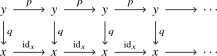 induces a map \(u\colon x'\to x\). Similarly, the sequence of commutative squares
associated to the relation \(p\circ s=s\circ q\circ s=s\)
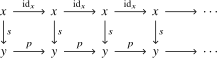 induces a map \(v\colon x\to x'\). It is clear that \(u\circ v=\id_{x}\) by functoriality,
since \(q\circ s=\id_x\).
Finally, the composition \(v\circ u\) is the colimit of the diagram
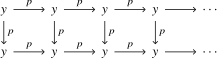 that is the identity of \(x'\), by a cofinality argument as at the end of the proof
of Lemma 17.4.2.