Proposition 4.4.16. Let \(f\colon C \to D\) be a left (resp. right) Bousfield localization. Then \(f\) is a localization, in the sense of Definition 3.3.6.
Proof
Let \(s\colon D \to C\) be a left adjoint section of \(f\), with identification \(\eta: \id_D = f s\) and counit \(\epsilon\colon s f \to \id_C\). For any category \(E\), the induced functor
\[
f^*\colon \Fun(D,E) \to \Fun(C,E)
\]
is a left adjoint section of \(s^*\colon \Fun(C,E) \to \Fun(D,E)\), see Proposition 4.4.4. Let \(W \hookrightarrow \Map([1],C)\) denote the collection of morphisms in \(C\) that are sent to isomorphisms in \(D\) under \(f\), i.e. 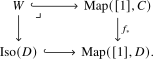 Since the map \(f(\epsilon_x) \colon f(s(f(x))) \to f(x)\) is an isomorphism by the triangle identity, it follows that the map \(\epsilon_x\colon s(f(x)) \to x\) lies in \(W\) for any object \(x\) of \(C\). In particular, for any functor \(F\colon C \to E\) in \(\Fun^W(C,E)\), the counit of the adjunction \(f^* \dashv s^*\) is a natural isomorphism: \(f^* s^*F \iso F\). It follows that this adjunction restricts to an adjunction
\[
f^*\colon \Fun(D,E) \rightleftarrows \Fun^W(C,E) \noloc s^*
\]
in which both the unit and counit are equivalences. We conclude that the induced functor
\[
f^*\colon \Fun(D,E) \to \Fun^W(C,E)
\]
is an equivalence, showing that \(f\) exhibits \(D\) as a localization of \(C\) at \(W\) as desired.
From Section 4.4, Adjunctions.