Proposition 4.4.18 (Idempotent localization criterion). Let \(L\colon C \to C\) be a functor equipped with a natural transformation \(\eta\colon \id_C \Rightarrow L\). Assume that both \[ \eta_{Lx}\colon Lx \to LLx \qquad\text{and}\qquad L\eta_x\colon Lx \to LLx \] are isomorphisms for every object \(x\) of \(C\). Let \(D\subseteq C\) be the full subcategory spanned by those objects \(z\) for which \(\eta_z\) is an isomorphism. Then \(L\) factors through a functor \(l\colon C\to D\) which is left adjoint to the inclusion \(i\colon D\hookrightarrow C\), with unit \(\eta\). In particular, \(l\) is a left Bousfield localization.
Proof
We first construct \(D\) by the pullback
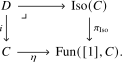 Here the bottom functor is the one encoding the transformation \(\eta\).
By Propositions 3.4.4 and 3.4.5, the right-hand
functor is a full subcategory. Its pullback therefore exhibits \(D\) as the
claimed full subcategory of \(C\). Since every \(\eta_{Lx}\) is invertible,
we may use the characterization of Corollary 3.2.8
to get a factorization \(l \colon C \to D\) of \(L\) through \(D\). Note that every \(z:D\) is isomorphic to
\(Lz\) via \(\eta_z\), so \(D\) contains precisely the objects in the essential image of \(L\).
By the pointwise criterian for natural isomorphisms (Proposition 3.4.6), the transformations \(\eta L\) and \(L\eta\) are invertible. We claim that \(\eta L = L\eta\). Applying Lemma 2.2.10 to \(\eta\) twice gives \[ (L\eta)\circ\eta = (\eta L)\circ\eta. \] Whiskering with \(L\) on the left gives \((LL\eta)\circ(L\eta) = (L\eta L)\circ(L\eta)\), and since \(L\eta\) is invertible we obtain \(L^2\eta = L\eta L\). Similarly, naturality of \(\eta L\) gives \[ (L\eta L)\circ(\eta L) = (\eta L^2)\circ(\eta L), \] and since \(\eta L\) is invertible we deduce \(L\eta L = \eta L^2\). Finally, naturality applied to \(L\eta\) gives \[ (L^2\eta)\circ(\eta L) = (\eta L^2)\circ(L\eta). \] Plugging in the preceding two identifications and cancelling the invertible transformation \(\eta L^2\) then proves the claim.
We now establish the adjunction \(l \vdash i\). Consider the restricted transformation \(\eta i\colon i\to ili\), which is invertible by construction. By the universal property of the subcategory inclusion \(i\colon D \hookrightarrow C\), it lifts to an invertible transformation \(\id_D\to li\), and we let \(\varepsilon\colon li\to\id_D\) be its inverse. Then we have \[ (i\varepsilon)\circ(\eta i) = \id_i \] by construction. For the other triangle identity \((\varepsilon l)\circ(l\eta) = \id_l\), we may again check this after applying \(i\). But there we have \[ (i\varepsilon l)\circ(il\eta) = (\eta L)^{-1}\circ(L\eta) = \id_L. \] We conclude that we have an adjunction \(l\dashv i\), with unit \(\eta\) and invertible counit \(\varepsilon\), as required.
From Section 4.4, Adjunctions.