Proposition 3.4.6 (Objectwise criterion for natural isomorphisms). Let \(f,g\colon C\to D\) be functors and let \(\alpha\colon f\to g\) be a natural transformation. Then \(\alpha\) is a natural isomorphism if and only if \(\alpha_x\colon f(x)\to g(x)\) is an isomorphism for every object \(x\) of \(C\).
Proof
By Propositions 3.4.4 and 3.4.5,
the functor \(\Iso(D)\to\Fun([1],D)\) is a full subcategory. Unwinding, this means
we have a pullback square
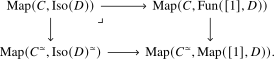 The transformation \(\alpha\) determines a term of the upper right corner,
and the right-hand map restricts it to its components. If every component
is invertible, applying this hypothesis to the universal object in the
anima \(C^{\simeq}\) gives a lift to the lower left corner. The pullback
property then supplies a lift \(C\to\Iso(D)\) of the functor encoding \(\alpha\).
It follows from Lemma 1.7.11 that
\(\Fun(C,\Iso(D)) \simeq \Iso(\Fun(C,D))\), so that this lift provides the
inverse data for \(\alpha\) in \(\Fun(C,D)\), showing that \(\alpha\) is a natural
isomorphism. Conversely, evaluation at each object sends an inverse of
\(\alpha\) to an inverse of its component.