We begin by introducing the notion of the directed pullback of two functors.
Construction 4.1.1 (Directed pullback). Consider two functors \(f\colon A \to C\) and \(g\colon B \to C\). We define the directed pullback \(A \vectimes{f,g} B\) of \(A\) and \(B\) over \(C\) (sometimes called ‘lax pullback’) via the pullback square
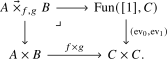 Note that a term of \(A \vectimes{f,g} B\) consists of a triple \((a,b,\phi)\) where \(a\) is a term of \(A\), \(b\) is a term of \(B\), and \(\phi\colon f(a) \to g(b)\) is a morphism in \(C\).
We often abuse notation and write \(A \vectimes{g} B\) in the case where \(C = A\) and \(f = \id_A\colon A \to A\) and dually write \(A \vectimes{f} B\) when \(C = B\) and \(g = \id_B\colon B \to B\).
Given a commutative diagram
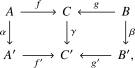 we obtain an induced functor
\begin{align*}
\alpha \vectimes{\gamma} \beta \colon A \vectimes{f,g} B &\to A' \vectimes{f',g'} B', \\
(a,b,\phi) &\mapsto (\alpha(a),\beta(b),\gamma(\phi)),
\end{align*}
where \(\gamma(\phi)\) is the map
\[
f'(\alpha(a)) = \gamma(f(a)) \to \gamma(g(b)) = g'(\beta(b))
\]
Remark 4.1.2. Combining Lemma 1.6.13 with the Rezk axiom (Axiom F), we obtain a pullback square
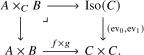 We will see in Corollary 6.4.12 below that the inclusion \(\pi_{\Iso}\colon \Iso(C) \hookrightarrow \Fun([1],C)\) is fully faithful, and Proposition 6.4.6 then identifies it as a full subcategory. Hence it induces a full subcategory \(A \times_C B \hookrightarrow A \vectimes{f,g} B\). Therefore, we may think of the pullback \(A \times_C B\) as the full subcategory of \(A \vectimes{f,g} B\) spanned by those triples \((a,b,\gamma)\) such that the map \(\gamma\colon f(a) \iso g(b)\) is an isomorphism in \(C\).
Construction 4.1.3 (Directed evaluation maps). Consider a functor \(f\colon A \to B\). We define the directed evaluation maps
\[
\begin{aligned}
\vec{\ev}^f_0\colon \Fun([1], A) &\to A \vectimes{f} B \\
(\phi\colon a \to a') &\mapsto (a,f(a'),f(\phi))
\end{aligned}
\qquadtext{ and }
\begin{aligned}
\vec{\ev}^f_1\colon \Fun([1],A) &\to B \vectimes{f} A \\
(\phi\colon a \to a') &\mapsto (f(a),a',f(\phi))
\end{aligned}
\]
via the following two commutative diagrams:
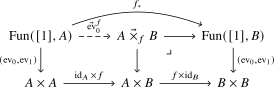 and
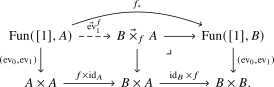
Remark 4.1.4. In case \(B = *\) there are equivalences \(A \vectimes{f} B \simeq A \simeq B \vectimes{f} A\) and the directed evaluation maps \(\vec{\ev}^f_0\) and \(\vec{\ev}^f_1\) simplify to the evaluation maps \(\ev_0,\ev_1\colon \Fun([1],A) \to A\).
For later use, we record various properties of the directed evaluation maps.
Lemma 4.1.5. Assume that \(f\colon A \to B\) is an equivalence. Then also \(\vec{\ev}^f_0\) and \(\vec{\ev}^f_1\) are equivalences.
Proof
For \(\vec{\ev}^f_0\), this follows from the 2-out-of-3 property applied to the following two maps: \[ \Fun([1],A) \xrightarrow{\vec{\ev}^f_0} A \vectimes{f} B \to \Fun([1],B). \] Indeed, the composite is induced by \(f\) and is hence an equivalence, and the second map is a base change of \(f\) and thus also an equivalence. The proof for \(\vec{\ev}^f_1\) is similar.
Lemma 4.1.6 (Base change). Consider a pullback square of the form
 Then the commutative square
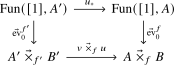 is a pullback square. The dual result for \(\vec{\ev}^f_1\) and \(\vec{\ev}^{f'}_1\) also holds.
Proof
Consider the following commutative diagram:
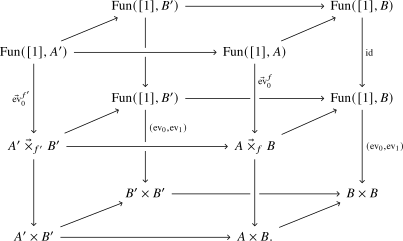 Observe that the bottom square is a pullback square, while the lower vertical squares on the left and right sides are pullback squares by definition of \(A' \vectimes{f'} B'\) and \(A \vectimes{f} B\). It follows by the pasting law of pullback squares that also the middle horizontal square is a pullback square. Since also the upper square at the back and the top square are pullback squares, it thus follows that the upper front square is a pullback square, as desired.
Lemma 4.1.7 (Composition). For functors \(f\colon A \to B\) and \(g\colon B \to C\), there is a commutative diagram
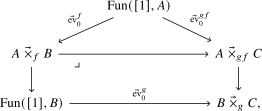 where the bottom square is a pullback square.
Proof
It is easy to verify that the diagram commutes, hence it remains to show that the bottom square is a pullback square. To this end, consider the following commutative diagram:
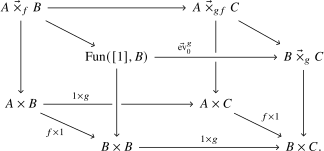 We want to show that the top square is a pullback square. The left square is a pullback square by definition and the bottom square is easily seen to be a pullback square, hence by the pasting law of pullback squares it will suffice to show that the right square is a pullback square. This follows from another instance of the pasting law, applied to the following commutative diagram:
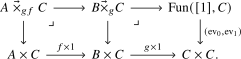 Indeed, by the definitions of \(A \vectimes{gf} C\) and \(B \vectimes{g} C\) the right and outer squares are pullback squares and hence so is the left square.
Lemma 4.1.8 (Retracts). Consider a retract diagram of functors:
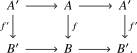 Then the map \(\vec{\ev}_0^{f'}\) is a retract of \(\vec{\ev}_0^f\):
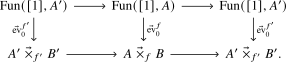
Proof
This is an immediate consequence of the definitions.