Proposition 6.4.6. Consider a functor \(f\colon C \to D\). Then the following conditions are equivalent:
(1) The functor \(f\) is fully faithful;
(2) The functor \(f^{\simeq}\colon C^{\simeq} \to D^{\simeq}\) is an embedding and the canonical functor \(C \to \lra{C^{\simeq} \subseteq D}\) is an equivalence;
(3) The functor \(f\) exhibits \(C\) as a full subcategory of \(D\), in the sense of Definition 3.2.2.
Proof
First note that in all three cases the induced map \(f^{\simeq}\colon C^{\simeq} \to D^{\simeq}\) is an embedding, where in case (1) we use Corollary 6.4.2.
To prove that (1) implies (2), assume that \(f\) is fully faithful. We already argued that \(f^{\simeq}\colon C^{\simeq} \to D^{\simeq}\) is an embedding. To show that \(C \to \lra{C^{\simeq} \subseteq D}\) is an equivalence, it suffices by Corollary 6.3.9 to show that the induced functor \(\Map([1],C) \to \Map([1],\lra{C^{\simeq} \subseteq D})\) is an equivalence. By Corollary 3.2.8, this is equivalent to the condition that the top square in the following commutative diagram is a pullback square:
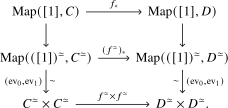 Since the bottom two vertical maps are equivalences by Axiom C.1, the bottom square is always a pullback square, hence by the pasting law for pullback squares it will suffice to show that the outer square is a pullback square. But this is precisely the full faithfulness of \(f\).
The fact that (2) implies (3) follows from Proposition 3.2.7, which shows that the functor \(\lra{C^{\simeq} \subseteq D} \to D\) is a full subcategory, together with the equivalence \(C \iso \lra{C^{\simeq} \subseteq D}\) from (2).
Finally, condition (3) demands that for every category \(B\) the commutative square
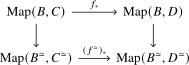 is a pullback square, and as explained above this square for \(B = [1]\) precisely says that \(f\) is fully faithful, giving (1).