We apply the adjoint criterion to construct inverses to functors that are fully faithful and strongly surjective. This gives the Fundamental Theorem and, as a consequence, detection of equivalences by the anima of arrows.
Definition 6.3.1 (Fully faithful). A functor \(f\colon C \to D\) is said to be fully faithful if for all objects \(x\) and \(y\) of \(C\) the induced functor \[ f\colon C(x,y) \to D(f(x), f(y)) \] on hom animae is an equivalence.
Remark 6.3.2. The map \(C(x,y) \to D(f(x), f(y))\) is obtained by passing to fibers over \((x,y)\) in the following commutative diagram:
 where we use Corollary 3.4.9 to identify the fibers of the two vertical maps with \(C(x,y)\) and \(D(f(x),f(y))\), respectively. It follows that fully faithfulness of \(f\) is equivalent to the condition that Equation (6.9) is a pullback square.
Corollary 6.3.3. Let \(f\colon C \to D\) and \(g\colon D \to E\) be two functors such that \(g\) is fully faithful. Then \(f\) is fully faithful if and only if \(gf\colon C \to E\) is fully faithful.
Proof
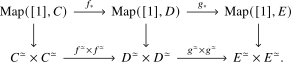
This follows from applying the pasting lemma for pullbacks to the following commutative diagram:
Example 6.3.4. Every equivalence \(u\colon C \iso D\) is fully faithful, see Exercise 6.7.1.
Proposition 6.3.5. If a functor \(f\colon C \to D\) is fully faithful, then it reflects isomorphisms: if \(f(u)\) is invertible, then \(u\) is invertible.
Proof
Consider a morphism \(u\colon x \to y\) in \(C\) whose image \(f(u)\) in \(D\) is invertible. We will show that \(u\) admits a left inverse; the argument for the existence of a right inverse will be analogous. Since \(f(u)\) is invertible in \(D\), it admits a left inverse \(v\colon f(y) \to f(x)\), i.e. we have \(vf(u) = \id_{f(x)}\). Since \(f\) is fully faithful, there exists a morphism \(\tilde{v}\colon y \to x\) in \(C\) satisfying \(f(\tilde{v}) = v\). We claim that the relation \(\tilde{v}u = \id_x\) is satisfied. Since \(f\) is fully faithful, it suffices to show that \(f(\tilde{v}u) = f(\id_x)\). But since \(f\) preserves identities and compositions, this is equivalent to the relation \(f(\tilde{v})f(u) = vf(u) = \id_{f(x)}\), which holds by assumption.
Definition 6.3.6 (Strongly surjective functor). We say that a functor \(f\colon C \to D\) is strongly surjective if it comes equipped with a section \(s\colon D^{\simeq} \to C^{\simeq}\) of the underlying map \(f^{\simeq}\colon C^{\simeq} \to D^{\simeq}\) on groupoid cores.
Remark 6.3.7. Using the contextual convention from Convention 5.4.4, note that \(f\) is strongly surjective if and only if for every object \(d\) of \(D\) there exists an object \(c\) in \(C\) together with an isomorphism \(f(c) \iso d\) in \(D\). For this reason, this notion was previously called ‘essential surjectivity’ in this text.
Theorem 6.3.8 (Fundamental theorem of category theory). A functor \(f\colon C \to D\) is an equivalence if and only if it is fully faithful and strongly surjective.
Proof
It is clear that every equivalence is fully faithful and strongly surjective. Conversely, let \(f\colon C \to D\) be a functor which is fully faithful and strongly surjective. Our goal is to show that \(f\) is an equivalence.
We apply Theorem 6.2.1 to construct a right adjoint of \(f\). Strong surjectivity gives a functor \(c\colon D^{\simeq}\to C\) and an isomorphism \(e\colon fc=\imath_D\). For each object \(d\) of \(D\), consider the object \((c_d,e_d)\) of the relative slice \(C_{/d}\).
For an object \((x,u\colon f(x)\to d)\) of this slice, its hom anima into \((c_d,e_d)\) is the fiber over \(u\) of \[ C(x,c_d)\xrightarrow{f}D(f(x),f(c_d))\xrightarrow{e_d\circ-}D(f(x),d). \] This is an equivalence by full faithfulness and invertibility of \(e_d\), so the fiber is contractible. This calculation takes place in the iterated context \(d:D^{\simeq},(x,u):(C_{/d})^{\simeq}\) of the universal object of \(D\) and the universal object of its relative slice. By Lemma 6.1.10, \((c_d,e_d)\) is terminal in \(C_{/d}\).
The general adjoint criterion and its refinement, Remark 6.2.2, therefore give a right adjoint \(g\) of \(f\) with values \(c_d\) and counit components \(e_d\). We use the construction in that proof: writing \(E=C\vectimes{f}D\) with projections \(p\colon E\to D\) and \(q\colon E\to C\), the chosen terminal objects extend to a right adjoint section \(s\colon D\to E\) of \(p\). The functor \(q\) has the left adjoint section \(i(x)=(x,\id_{f(x)})\), and \(f=pi\) has right adjoint \(g=qs\). We retain the specified identification of \(s\) with the chosen section over \(D^{\simeq}\).
Recall that the adjoint \(g\) we obtain is given by a composite of adjoints, as displayed as follows:
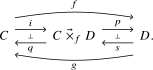 Let \(\alpha\colon \id_C \to qi\) be the unit isomorphism of the left adjoint section \(i\) of \(q\), let \(\eta\colon \id_{C \vectimes{f} D} \to sp\) be the unit of the adjunction \(p \dashv s\), let \(\epsilon\colon iq \to \id_{C \vectimes{f} D}\) be the counit of the adjunction \(i \dashv q\), and let \(\delta\colon ps \to \id_D\) be the counit isomorphism of the right adjoint section \(s\) of \(p\). The counit and unit of the composite adjunction \(f=pi \dashv qs=g\) are
\[
fg = p i q s \xrightarrow{p \epsilon s} p s \xrightarrow{\delta} \id_D
\]
and
\[
\id_C \xrightarrow{\alpha} qi \xrightarrow{q\eta i} q s p i = gf,
\]
respectively. Since \(\alpha\) and \(\delta\) are already natural isomorphisms, it remains to show that \(p\epsilon s\) and \(q\eta i\) are natural isomorphisms.
For an object \((x,u\colon f(x) \to y)\) of \(C \vectimes{f}D\), the component \(p\epsilon_{(x,u)}\) is the morphism \(u\colon f(x) \to y\). In particular, at the chosen object \(s(y)=(c_y,e_y)\) it is the isomorphism \[ p\epsilon_{s(y)}=e_y\colon f(c_y) \iso y. \] Thus \(p\epsilon s\) is objectwise an isomorphism, and hence is a natural isomorphism by Proposition 3.4.6.
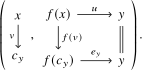
To show that \(q\eta i\) is a natural isomorphism, it will by Proposition 3.4.6 suffice to do so on objects. We first describe the transformation \(\eta\colon \id_{C \vectimes{f} D} \to sp\) at an object \((x,u\colon f(x) \to y)\). Write \(s(y)=(c_y,e_y)\) as above. By full faithfulness, there is a morphism \(v\colon x \to c_y\) and an identification \(e_y f(v) = u\). The map \(\eta_{(x,u)}\colon (x,u) \to (c_y,e_y)\) is given by the following morphism (to be read from top to bottom):
 Now evaluate at \(i(x)=(x,\id_{f(x)})\). The resulting morphism \(q\eta_{i(x)}\) is a map \(v\colon x \to c_{f(x)}\) such that \(e_{f(x)} f(v) = \id_{f(x)}\). Thus \(f(v)\) is an isomorphism. Since a fully faithful functor is conservative by Proposition 6.3.5, \(v\) is an isomorphism. Hence \(q\eta i\) is objectwise an isomorphism and therefore a natural isomorphism.
Corollary 6.3.9. A functor \(f\colon C \to D\) is an equivalence if and only if the induced map \[ f_*\colon \Map([1],C) \to \Map([1],D) \] is an equivalence.
Proof
If \(f\) is an equivalence, it is clear that \(f_*\) is an equivalence. Conversely, assume that \(f_*\) is an equivalence. By Theorem 6.3.8, it will suffice to show that \(f\) is strongly surjective and fully faithful. Consider the following commutative diagram:
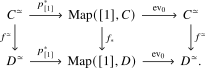 It follows that \(f^{\simeq}\) is a retract of \(f_*\), and thus in particular it is an equivalence. In particular, \(f\) is strongly surjective. Now consider the following commutative diagram:
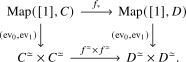 Since the top and bottom maps are equivalences, it follows that the square is a pullback square, and thus \(f\) is fully faithful by Remark 6.3.2.
Remark 6.3.10. The preceding arguments show that the following principles are equivalent, relative to the axioms of the previous chapters:
(1) Universals are functorial, in the sense of Definition 6.1.4.
(2) The functor \(\Map([1],-)\) detects equivalences.
(3) A functor is an equivalence if and only if it is fully faithful and strongly surjective.
The implication (2) \(\implies\) (1) is Proposition 6.1.6. Under the hypothesis (1), Theorem 6.3.8 proves (3). Finally, the proof of Corollary 6.3.9 uses only the criterion (3), together with the preceding chapters and the elementary description of full faithfulness, to deduce (2). The proof of (2) \(\implies\) (1) precedes Axiom L and does not use it.