Theorem 6.3.8 (Fundamental theorem of category theory). A functor \(f\colon C \to D\) is an equivalence if and only if it is fully faithful and strongly surjective.
Proof
It is clear that every equivalence is fully faithful and strongly surjective. Conversely, let \(f\colon C \to D\) be a functor which is fully faithful and strongly surjective. Our goal is to show that \(f\) is an equivalence.
We apply Theorem 6.2.1 to construct a right adjoint of \(f\). Strong surjectivity gives a functor \(c\colon D^{\simeq}\to C\) and an isomorphism \(e\colon fc=\imath_D\). For each object \(d\) of \(D\), consider the object \((c_d,e_d)\) of the relative slice \(C_{/d}\).
For an object \((x,u\colon f(x)\to d)\) of this slice, its hom anima into \((c_d,e_d)\) is the fiber over \(u\) of \[ C(x,c_d)\xrightarrow{f}D(f(x),f(c_d))\xrightarrow{e_d\circ-}D(f(x),d). \] This is an equivalence by full faithfulness and invertibility of \(e_d\), so the fiber is contractible. This calculation takes place in the iterated context \(d:D^{\simeq},(x,u):(C_{/d})^{\simeq}\) of the universal object of \(D\) and the universal object of its relative slice. By Lemma 6.1.10, \((c_d,e_d)\) is terminal in \(C_{/d}\).
The general adjoint criterion and its refinement, Remark 6.2.2, therefore give a right adjoint \(g\) of \(f\) with values \(c_d\) and counit components \(e_d\). We use the construction in that proof: writing \(E=C\vectimes{f}D\) with projections \(p\colon E\to D\) and \(q\colon E\to C\), the chosen terminal objects extend to a right adjoint section \(s\colon D\to E\) of \(p\). The functor \(q\) has the left adjoint section \(i(x)=(x,\id_{f(x)})\), and \(f=pi\) has right adjoint \(g=qs\). We retain the specified identification of \(s\) with the chosen section over \(D^{\simeq}\).
Recall that the adjoint \(g\) we obtain is given by a composite of adjoints, as displayed as follows:
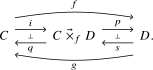 Let \(\alpha\colon \id_C \to qi\) be the unit isomorphism of the left adjoint section \(i\) of \(q\), let \(\eta\colon \id_{C \vectimes{f} D} \to sp\) be the unit of the adjunction \(p \dashv s\), let \(\epsilon\colon iq \to \id_{C \vectimes{f} D}\) be the counit of the adjunction \(i \dashv q\), and let \(\delta\colon ps \to \id_D\) be the counit isomorphism of the right adjoint section \(s\) of \(p\). The counit and unit of the composite adjunction \(f=pi \dashv qs=g\) are
\[
fg = p i q s \xrightarrow{p \epsilon s} p s \xrightarrow{\delta} \id_D
\]
and
\[
\id_C \xrightarrow{\alpha} qi \xrightarrow{q\eta i} q s p i = gf,
\]
respectively. Since \(\alpha\) and \(\delta\) are already natural isomorphisms, it remains to show that \(p\epsilon s\) and \(q\eta i\) are natural isomorphisms.
For an object \((x,u\colon f(x) \to y)\) of \(C \vectimes{f}D\), the component \(p\epsilon_{(x,u)}\) is the morphism \(u\colon f(x) \to y\). In particular, at the chosen object \(s(y)=(c_y,e_y)\) it is the isomorphism \[ p\epsilon_{s(y)}=e_y\colon f(c_y) \iso y. \] Thus \(p\epsilon s\) is objectwise an isomorphism, and hence is a natural isomorphism by Proposition 3.4.6.
To show that \(q\eta i\) is a natural isomorphism, it will by Proposition 3.4.6 suffice to do so on objects. We first describe the transformation \(\eta\colon \id_{C \vectimes{f} D} \to sp\) at an object \((x,u\colon f(x) \to y)\). Write \(s(y)=(c_y,e_y)\) as above. By full faithfulness, there is a morphism \(v\colon x \to c_y\) and an identification \(e_y f(v) = u\). The map \(\eta_{(x,u)}\colon (x,u) \to (c_y,e_y)\) is given by the following morphism (to be read from top to bottom):
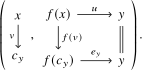 Now evaluate at \(i(x)=(x,\id_{f(x)})\). The resulting morphism \(q\eta_{i(x)}\) is a map \(v\colon x \to c_{f(x)}\) such that \(e_{f(x)} f(v) = \id_{f(x)}\). Thus \(f(v)\) is an isomorphism. Since a fully faithful functor is conservative by Proposition 6.3.5, \(v\) is an isomorphism. Hence \(q\eta i\) is objectwise an isomorphism and therefore a natural isomorphism.
From Section 6.3, The Fundamental Theorem of category theory.