An adjoint assigns a universal arrow to each object of its target. Functoriality of universals lets us assemble these arrows into an adjunction. We first express this through terminal objects in relative slices, then give the corresponding criterion on hom animae. For an object \(d\) of \(D\), the relative slice \(C_{/d}\) and its terminal object are taken in the anima context of \(d\).
Theorem 6.2.1. Let \(f\colon C \to D\) be a functor. Then the following conditions are equivalent:
(1) The functor \(f\) admits a right adjoint \(g\colon D \to C\);
(2) The projection functor \(p\colon C \vectimes{f} D \to D\) admits a right adjoint section \(s\colon D \to C \vectimes{f} D\);
(3) For every object \(d\) in \(D\), the relative slice \(C_{/d} = C \times_D D_{/d}\) admits a terminal object \(s_d\).
Dually, \(f\) admits a left adjoint if and only if the projection functor \(D \vectimes{f} C \to D\) admits a left adjoint section, or equivalently if and only if the relative coslice \(C_{d/}\) admits an initial object for every object \(d\) of \(D\).
Remark 6.2.2. We will in fact prove the following somewhat more refined statement: assume that for every object \(d\) of \(D\), the relative slice \(C_{/d}\) admits a terminal object \(s_d = (g_d, \epsilon_d)\), where \(g_d\) is an object of \(C\) and \(\epsilon_d\colon f(g_d) \to d\) is a morphism in \(D\). Then the right adjoint \(g\colon D \to C\) of \(f\) may be chosen in such a way that for every object \(d\) of \(D\) the following two conditions are satisfied:
• There is an identification \(g_d = g(d)\);
• Under this isomorphism, the counit map \(\epsilon\colon f(g(d)) \to d\) of the adjunction corresponds to the given map \(\epsilon_d\colon f(g_d) \to d\).
Proof of Theorem 6.2.1
We will prove the equivalence between (1), (2) and (3), and leave the dual claim to the reader. Recall from Construction 4.1.1 the directed pullback \(C \vectimes{f} D\), defined via the following pullback diagram:
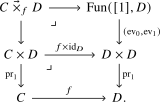 Objects of \(C \vectimes{f} D\) are pairs \((x,u)\) where \(x\) is an object in \(C\) and \(u\) is an object in \(\Fun([1],D)\) of the form \(u\colon f(x) \to y\). There are two canonical projection maps
\[
p\colon C \vectimes{f} D \to D \qquadtext{ and } q \colon C \vectimes{f} D \to C
\]
which are given on terms by \(p(x,u\colon f(x) \to y) = y\) and \(q(x,u) = x\). We have:
• The functor \(p\) is a cocartesian fibration by Proposition 4.6.5;
• The functor \(q\) is a base change of the evaluation map \(\ev_0\colon \Fun([1],D) \to D\). Since \(\ev_0\) admits a left adjoint section given by \(y \mapsto \id_y\) by Lemma 4.4.11, we get that also \(q\) admits a left adjoint section \(i\colon C \to C \vectimes{f} D\) given by \(i(x) = (x, f(x) \xrightarrow{=} f(x))\).
• The composite \[ C \xrightarrow{i} C \vectimes{f} D \xrightarrow{p} D \] is identified with \(f\).
For (1) \(\implies\) (2), recall from Proposition 4.4.7 that the data of an adjunction \(f \dashv g\) is equivalent to the data of an equivalence \(C \vectimes{f} D \simeq C \vectimes{g} D\) over \(C \times D\). We may therefore equivalently show that the projection \(C \vectimes{g} D \to D\) admits a right adjoint section. But this follows from Lemma 4.4.11, as this map is a base change of the evaluation functor \(\ev_1\colon \Fun([1],C) \to C\).
For (2) \(\implies\) (1), assume that \(p\) admits a right adjoint section \(s\colon D \to C \vectimes{f} D\). Since adjunctions compose by Proposition 4.4.3, we conclude that the composite \(g := qs\colon D \to C\) is the desired right adjoint of \(f = pi\):
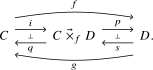 A right adjoint section restricts to terminal objects in the fibers, by Lemma 4.4.21 and its dual. Conversely, apply functoriality of universals to the terminal objects in (3), considered in context \(d:D^{\simeq}\). Since \(p\) is cocartesian, they extend to a right adjoint section of \(p\), proving (2).
For the refined statement from Remark 6.2.2, we use that the terminal objects \(s_d = (g_d,\epsilon_d)\) of the relative slices \(C_{/d}\) assemble into the right adjoint section \(s\colon D \to C \vectimes{f} D\), with counit \(ps = \id_D\). The right adjoint \(g\) of \(f\) is then given by \(qs\), with counit \(fg \to \id_D\) given by the composite \[ fg(d) = piqs(d) \xrightarrow{p\epsilon'_{s(d)}} ps(d) = d, \] where the transformation \(\epsilon'\colon iq \to \id_{C \vectimes{f} D}\) is the counit of the adjunction \(i \dashv q\). After unwinding the definitions, one sees that this map is precisely the given map \(\epsilon_d\colon f(g_d) \to d\), as claimed.
Proposition 6.2.3 (Pointwise criterion for adjunctions). Let \(f\colon C \to D\) be a functor. Assume that, for every object \(d \in D\), we are given an object \(g(d)\) in \(C\) together with a morphism \(\epsilon_d\colon f(g(d)) \to d\) (resp. \(\eta_d\colon d \to f(g(d))\)) such that for any object \(c\) in \(C\) the map \[ C(c,g(d)) \xrightarrow{f} D(f(c), f(g(d))) \xrightarrow{\epsilon_d \circ -} D(f(c),d) \] is an equivalence (resp. for every \(c\) in \(C\) the map \[ C(g(d),c) \xrightarrow{f} D(f(g(d)), f(c)) \xrightarrow{- \circ \eta_d} D(d,f(c)) \] is an equivalence.) Then there is a right adjoint (resp. left adjoint) \(g\colon D \to C\) of \(f\) such that \(g(d)\) coincides on objects with the data above, and the counit (resp. unit) is on objects given by the maps \(\epsilon_d\) (resp. \(\eta_d\)).
Proof
We will only prove the first case; the other case is dual. By Theorem 6.2.1 it suffices to check that, for each object \(d\) of \(D\), the pair \((g(d),\epsilon_d)\) is a terminal object of the relative slice \(C_{/d} = C \times_D D_{/d}\). By Lemma 6.1.10, it suffices to show that the hom anima \(\Hom_{C_{/d}}((c,\alpha), (g(d),\epsilon_d))\) is contractible for any object \((c,\alpha\colon f(c) \to d)\) of \(C_{/d}\). Work in the iterated context \(d:D^{\simeq},(c,\alpha):(C_{/d})^{\simeq}\) of the universal object of \(D\) and the universal object of its relative slice. By definition of \(C_{/d}\) as a pullback, we may compute this hom anima via the following pullback diagram, where \(*\) is the terminal category in this context:
 But since the bottom composite is assumed to be an equivalence, we see that the top composite is also an equivalence, and so the left-upper corner is contractible as desired. This finishes the proof.
Proposition 6.2.4 (Base change of a right adjoint along a cocartesian fibration). Consider a pullback square
 such that \(p\) is a cocartesian fibration. If \(v\) admits a left adjoint, then also \(u\) admits a left adjoint.
Proof
By the dual statement of Theorem 6.2.1, the projection \(D \vectimes{v} D' \to D\) admits a left adjoint section. Consider the pullback square
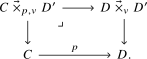 It follows that the projection \(C \vectimes{p,v} D' \to C\) admits a left adjoint section. A term of \(C \vectimes{p,v} D'\) is a triple \((c,d',\alpha)\) with \(\alpha\colon p(c)\to v(d')\). There is also a pullback square
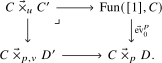 The lower horizontal map sends \((c,d',\alpha)\) to \((c,v(d'),\alpha)\). Thus the upper left corner consists of a morphism \(c\to c_1\) in \(C\), an object \(d'\) of \(D'\), and a specified identification \(p(c_1) = v(d')\), which is precisely a term of \(C \vectimes{u} C'\). Since \(p\) is a cocartesian fibration, \(\vec{\ev}^{p}_0\) admits a left adjoint section. Functors admitting left adjoint sections are stable under base change and composition, so the composite projection \(C \vectimes{u} C' \to C \vectimes{p,v} D' \to C\) admits a left adjoint section. Applying the dual statement of Theorem 6.2.1 once more shows that \(u\) admits a left adjoint.