Theorem 6.2.1. Let \(f\colon C \to D\) be a functor. Then the following conditions are equivalent:
(1) The functor \(f\) admits a right adjoint \(g\colon D \to C\);
(2) The projection functor \(p\colon C \vectimes{f} D \to D\) admits a right adjoint section \(s\colon D \to C \vectimes{f} D\);
(3) For every object \(d\) in \(D\), the relative slice \(C_{/d} = C \times_D D_{/d}\) admits a terminal object \(s_d\).
Dually, \(f\) admits a left adjoint if and only if the projection functor \(D \vectimes{f} C \to D\) admits a left adjoint section, or equivalently if and only if the relative coslice \(C_{d/}\) admits an initial object for every object \(d\) of \(D\).
Proof of Theorem 6.2.1
We will prove the equivalence between (1), (2) and (3), and leave the dual claim to the reader. Recall from Construction 4.1.1 the directed pullback \(C \vectimes{f} D\), defined via the following pullback diagram:
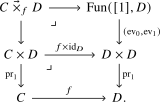 Objects of \(C \vectimes{f} D\) are pairs \((x,u)\) where \(x\) is an object in \(C\) and \(u\) is an object in \(\Fun([1],D)\) of the form \(u\colon f(x) \to y\). There are two canonical projection maps
\[
p\colon C \vectimes{f} D \to D \qquadtext{ and } q \colon C \vectimes{f} D \to C
\]
which are given on terms by \(p(x,u\colon f(x) \to y) = y\) and \(q(x,u) = x\). We have:
• The functor \(p\) is a cocartesian fibration by Proposition 4.6.5;
• The functor \(q\) is a base change of the evaluation map \(\ev_0\colon \Fun([1],D) \to D\). Since \(\ev_0\) admits a left adjoint section given by \(y \mapsto \id_y\) by Lemma 4.4.11, we get that also \(q\) admits a left adjoint section \(i\colon C \to C \vectimes{f} D\) given by \(i(x) = (x, f(x) \xrightarrow{=} f(x))\).
• The composite \[ C \xrightarrow{i} C \vectimes{f} D \xrightarrow{p} D \] is identified with \(f\).
For (1) \(\implies\) (2), recall from Proposition 4.4.7 that the data of an adjunction \(f \dashv g\) is equivalent to the data of an equivalence \(C \vectimes{f} D \simeq C \vectimes{g} D\) over \(C \times D\). We may therefore equivalently show that the projection \(C \vectimes{g} D \to D\) admits a right adjoint section. But this follows from Lemma 4.4.11, as this map is a base change of the evaluation functor \(\ev_1\colon \Fun([1],C) \to C\).
For (2) \(\implies\) (1), assume that \(p\) admits a right adjoint section \(s\colon D \to C \vectimes{f} D\). Since adjunctions compose by Proposition 4.4.3, we conclude that the composite \(g := qs\colon D \to C\) is the desired right adjoint of \(f = pi\):
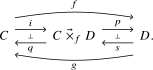 A right adjoint section restricts to terminal objects in the fibers, by Lemma 4.4.21 and its dual. Conversely, apply functoriality of universals to the terminal objects in (3), considered in context \(d:D^{\simeq}\). Since \(p\) is cocartesian, they extend to a right adjoint section of \(p\), proving (2).
For the refined statement from Remark 6.2.2, we use that the terminal objects \(s_d = (g_d,\epsilon_d)\) of the relative slices \(C_{/d}\) assemble into the right adjoint section \(s\colon D \to C \vectimes{f} D\), with counit \(ps = \id_D\). The right adjoint \(g\) of \(f\) is then given by \(qs\), with counit \(fg \to \id_D\) given by the composite \[ fg(d) = piqs(d) \xrightarrow{p\epsilon'_{s(d)}} ps(d) = d, \] where the transformation \(\epsilon'\colon iq \to \id_{C \vectimes{f} D}\) is the counit of the adjunction \(i \dashv q\). After unwinding the definitions, one sees that this map is precisely the given map \(\epsilon_d\colon f(g_d) \to d\), as claimed.