Proposition 6.2.4 (Base change of a right adjoint along a cocartesian fibration). Consider a pullback square
 such that \(p\) is a cocartesian fibration. If \(v\) admits a left adjoint, then also \(u\) admits a left adjoint.
Proof
By the dual statement of Theorem 6.2.1, the projection \(D \vectimes{v} D' \to D\) admits a left adjoint section. Consider the pullback square
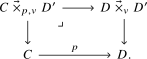 It follows that the projection \(C \vectimes{p,v} D' \to C\) admits a left adjoint section. A term of \(C \vectimes{p,v} D'\) is a triple \((c,d',\alpha)\) with \(\alpha\colon p(c)\to v(d')\). There is also a pullback square
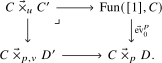 The lower horizontal map sends \((c,d',\alpha)\) to \((c,v(d'),\alpha)\). Thus the upper left corner consists of a morphism \(c\to c_1\) in \(C\), an object \(d'\) of \(D'\), and a specified identification \(p(c_1) = v(d')\), which is precisely a term of \(C \vectimes{u} C'\). Since \(p\) is a cocartesian fibration, \(\vec{\ev}^{p}_0\) admits a left adjoint section. Functors admitting left adjoint sections are stable under base change and composition, so the composite projection \(C \vectimes{u} C' \to C \vectimes{p,v} D' \to C\) admits a left adjoint section. Applying the dual statement of Theorem 6.2.1 once more shows that \(u\) admits a left adjoint.