Proposition 3.2.7. The inclusion \(\tilde{j}\colon \lra{\Gamma \subseteq C} \to C\) is a full subcategory, in the sense of Definition 3.2.2.
Proof
We showed in Lemma 3.2.6 that the induced functor \(\tilde{j}^{\simeq}\colon \lra{\Gamma \subseteq C}^{\simeq} \to C^{\simeq}\) agrees, under the preferred equivalence \(\lra{\Gamma \subseteq C}^{\simeq}\iso\Gamma\), with \(j\colon \Gamma \to C^{\simeq}\), hence is an embedding by assumption. We thus need to show that for every category \(D\), the top square in the following commutative diagram is a pullback square:
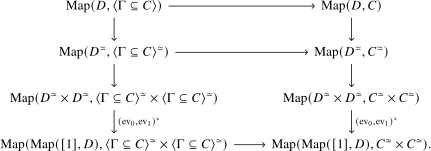 The bottom two horizontal maps are embeddings since they are induced by the embedding \(\lra{\Gamma \subseteq C}^{\simeq} \to C^{\simeq}\). The outer rectangle agrees with the outer pullback square in the proof of Lemma 3.2.6, hence is a pullback square itself. It then follows from Lemma 1.6.28 that the top square is also a pullback square.