In Lemma 4.2.13, we saw that any functor between left fibrations is compatible with the covariant transport functors. The situation is different for cocartesian fibrations: a functor between cocartesian fibrations is compatible with the covariant transport functors if and only if it preserves cocartesian morphisms. Functors satisfying this property are called cocartesian functors and will be made precise in this section.
Construction 4.7.1 (Beck-Chevalley transformation). Let \(p\colon C \to S\) and \(q\colon D \to S\) be two cocartesian fibrations, and consider a commutative triangle
 By definition of cocartesian fibrations, the map \(\vec{\ev}^p_0\colon \Fun([1],C) \to C \vectimes{p} S\) admits a left adjoint section \(\lift^p_0\), and similarly \(\vec{\ev}^q_0\) admits a left adjoint section \(\lift^q_0\). In particular, we have identifications \(\vec{\ev}^p_0 \lift^p_0 = \id\) and \(\vec{\ev}^q_0 \lift^q_0 = \id\), and transformations \(\epsilon_p \colon \lift^p_0 \vec{\ev}^p_0 \to \id\) and \(\epsilon_q \colon \lift^q_0 \vec{\ev}^q_0 \to \id\). Observe that we have a commutative diagram
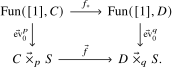 We now define the Beck-Chevalley transformation \(\BC_!\colon \lift^q_0\vec{f} \to f_*\lift^p_0\) as the following composite:
\[
\lift^q_0\vec{f} = \lift^q_0\vec{f}\vec{\ev}^p_0 \lift^p_0 = \lift^q_0 \vec{\ev}^q_0 f_* \lift^p_0 \xrightarrow{\epsilon_q} f_*\lift^p_0.
\]
Definition 4.7.2 (Cocartesian functor). The functor \(f\) over \(S\) as above is said to be a cocartesian functor over \(S\) if the natural transformation \(\BC_!\colon \lift^q_0\vec{f} \to f_*\lift^p_0\) is invertible.
There is a dual notion of a cartesian functor between cartesian fibrations over \(S\).
We can make the Beck-Chevalley transformation a bit more concrete as follows. For every morphism \(v\colon x \to y\) in \(S\) and every term \(a\) of \(C_x\), the map \(\BC_!(v)\colon \lift^q_0\vec{f}(a,v) \to f_*\lift^p_0(a,v)\) takes the form of a commutative square
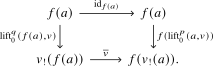 In this sense, we see that the Beck-Chevalley transformation induces a canonical morphism of functors
\[
\overline{v}\colon v_!\, f_{x}\to f_{y} v_!
\]
where \(v_!\colon C_x\to C_y\) and \(v_!\colon D_x\to D_y\) are the covariant transport functors
and \(f_x\colon C_x\to D_x\) is the functor induced by \(f\) on each fiber.
Lemma 4.7.3. Given two cocartesian fibrations \(p\colon C \to S\) and \(q\colon D \to S\), and a functor \(f\colon C \to D\) over \(S\), the following assertions are equivalent:
(i) The functor \(f\) is cocartesian over \(S\);
(ii) For any morphism \(v\colon x\to y\) in \(S\), the Beck-Chevalley comparison \(\overline{v}\) in the commutative square
 is a natural isomorphism;
(iii) The functor \(f\) sends locally \(p\)-cocartesian morphisms to locally \(q\)-cocartesian morphisms;
(iv) The functor \(f\) sends \(p\)-cocartesian morphisms to \(q\)-cocartesian morphisms.
Proof
Conditions (i) and (ii) are equivalent by the definition of the Beck-Chevalley transformation. The equivalence of (ii) and (iii) follows from the description of locally cocartesian lifts in Remark 4.8.11. Finally, (iii) and (iv) are equivalent by Lemma 4.8.10.
Example 4.7.4. For \(S = *\), every functor \(f\colon C \to D\) is a cocartesian functor over \(*\). Indeed, we have \(C \vectimes{p} * \simeq C\), with the directed evaluation map corresponding to \(\ev_0\colon \Fun([1],C) \to C\), which admits a left adjoint section \(p_{[1]}^*\colon C \to \Fun([1],C)\). The same holds for \(D\), and the claim follows from naturality of \(p_{[1]}^*\).
Corollary 4.7.5. Every equivalence \(C \iso D\) over \(S\) is a cocartesian functor.
Example 4.7.6. If \(p\) and \(q\) are left fibrations, then any functor \(f\) over \(S\) from \(C\) to \(D\) is a cocartesian functor over \(S\): this is a direct consequence of the fact that the two adjunctions \(\lift^p_0 \dashv \vec{\ev}^p_0\) and \(\lift^q_0 \dashv \vec{\ev}^q_0\) are adjoint equivalences.
Lemma 4.7.7. Consider cocartesian fibrations \(f\colon C \to D\) and \(q\colon D \to S\), and let \(p := qf\colon C \to S\) denote the composite cocartesian fibration from Proposition 4.5.14. Then \(f\) is a cocartesian functor over \(S\).
Proof
By construction of the Beck-Chevalley map, it will suffice to show that the map
\[
\lift^q_0\vec{\ev}^q_0f_*\lift^p_0 \xrightarrow{\epsilon_q} f_*\lift^p_0
\]
is an equivalence. Spelling out the left adjoint section \(\lift^p_0\) obtained from Proposition 4.5.14, we see that it sits in the following commutative diagram:
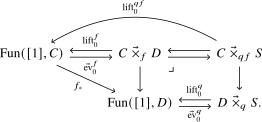 In particular, we see that \(f_*\lift^p_0\) factors through \(\lift^q_0\), and thus it suffices to show that the map
\[
\lift^q_0\vec{\ev}^q_0\lift^q_0 \xrightarrow{\epsilon_q\lift^q_0} \lift^q_0
\]
is an equivalence. But this is immediate from the triangle identities and the fact that the unit \(\id \to \vec{\ev}^q_0\lift^q_0\) of the adjunction \(\lift^q_0 \dashv \vec{\ev}^q_0\) is a natural isomorphism.
Proposition 4.7.8. For any category \(C\) the diagram
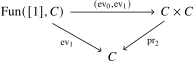 is a cocartesian functor over \(C\).
Since locally \(\ev_1\)-cocartesian morphisms in \(\Fun([1],C)\) precisely are those commutative squares in \(C\) of the form
 in which \(u\) is an isomorphism,
this is a direct consequence of:
Proposition 4.7.9. Let \(p\colon X\to B\) be any cocartesian fibration and \(u\colon X\to C\) any functor.
Then the diagram
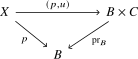 is a cocartesian functor over \(B\) if and only if the functor \(u\) sends locally \(p\)-cocartesian
morphisms to isomorphisms.
Proof
We know from Example 4.8.5 that the (locally) \(\pr_B\)-cocartesian morphisms in \(B\times C\) are nothing else than pairs \((u,v)\) with \(u\colon b_0\to b_1\) any morphism in \(B\) and \(v\colon c_0\to c_1\) any isomorphism in \(C\).
Definition 4.7.10. Let us consider a commutative square of categories of the form below.
 We assume that both \(p\) and \(q\) are cocartesian (cartesian) fibrations. We say that \(f\)
is a cocartesian functor over \(u\) (a cartesian functor over \(u\))
if the induced functor \(C\to S\times_TD\) is a cocartesian functor over \(S\)
(a cartesian functor over \(S\), respectively).
Remark 4.7.11. For a commutative square as in the definition above, the property that \(f\) is a (co)cartesian functor over \(u\) is equivalent to the property that it sends \(p\)-(co)cartesian morphisms in \(C\) to \(q\)-(co)cartesian morphisms in \(D\).
Proposition 4.7.12. For any functor \(f\colon C \to D\), the diagram
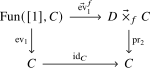 determines \(\vec{\ev}^f_1\) as a cocartesian functor over \(C\).
Proof
Recall that terms of \(D \vectimes{f} C\) are pairs \((u,x)\) where \(x\) is a term of \(C\) and
\(u\colon y\to f(x)\) is a morphism in \(D\).
In particular, morphisms in \(D \vectimes{f} C\) are essentially characterized as
morphisms \(\alpha\colon x\to x'\) in \(C\) together with commutative squares of the form
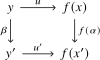 in \(D\). Such data yield a \(\pr_2\)-cocartesian morphism if and only if \(\beta\) is an isomorphism in \(D\)
(more precisely, the proof of Proposition 4.6.5 tells us that these are the morphisms isomorphic to morphisms obtained from such data with \(\beta\) an identity).
On the other hand \(\ev_1\)-cocartesian morphisms in \(\Fun([1],C)\) correspond to commutative squares
in which the left vertical map is an isomorphism. Its image under \(\vec{\ev}^f_1\) has left vertical map obtained by applying \(f\), hence again an isomorphism. It follows that the functor
\(\vec{\ev}^f_1\) preserves \(\ev_1\)-cocartesian morphisms, so that Lemma 4.7.3 applies to this situation.
Lemma 4.7.13. For a functor \(f\colon C \times [1] \to D\), the induced functor \((f, \pr_{[1]})\colon C \times [1] \to D \times [1]\) over \([1]\) is a cocartesian functor over \([1]\) if and only if \(f\) is a natural isomorphism of functors \(C \to D\).
Proof
Recall from Example 4.8.5 that the \(C\)-component of a cocartesian morphism in \(C \times [1]\) is necessarily invertible, and similarly for cocartesian morphisms in \(D \times [1]\). It follows that \((f, \pr_{[1]})\) is a cocartesian functor over \([1]\) if and only if for every term \(x\) of \(C\) the morphism \(f_x\colon \{x\} \times [1] \to D\) is invertible in \(D\). But this is equivalent to the condition that \(f\) is a natural isomorphism.
Proposition 4.7.14. Let \(p\colon C \to S\) and \(q\colon D \to S\) be cocartesian fibrations and let \(f\colon C \to D\) be a functor over \(S\). If \(f\) is a cocartesian functor over \(S\), then for every functor \(T \to S\) the induced functor \(f\times_S T \colon C \times_S T \to D \times_S T\) is a cocartesian functor over \(T\).
Proof
Let us abbreviate \(C_T := C \times_S T\), \(D_T := D \times_S T\), and \(f_T := f \times_S T\). By Proposition 4.5.15, the functors \(p_T\colon C_T \to T\) and \(q_T\colon D_T \to T\) are cocartesian fibrations. A morphism in \(C_T\) is \(p_T\)-cocartesian if and only if its image in \(C\) is \(p\)-cocartesian, by Observation 4.8.6 and Lemma 4.8.10. Since \(f\) preserves cocartesian morphisms, \(f_T\) sends every \(p_T\)-cocartesian morphism to a \(q_T\)-cocartesian morphism. The claim now follows from Lemma 4.7.3.