Proposition 4.7.12. For any functor \(f\colon C \to D\), the diagram
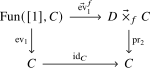 determines \(\vec{\ev}^f_1\) as a cocartesian functor over \(C\).
Proof
Recall that terms of \(D \vectimes{f} C\) are pairs \((u,x)\) where \(x\) is a term of \(C\) and
\(u\colon y\to f(x)\) is a morphism in \(D\).
In particular, morphisms in \(D \vectimes{f} C\) are essentially characterized as
morphisms \(\alpha\colon x\to x'\) in \(C\) together with commutative squares of the form
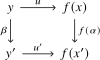 in \(D\). Such data yield a \(\pr_2\)-cocartesian morphism if and only if \(\beta\) is an isomorphism in \(D\)
(more precisely, the proof of Proposition 4.6.5 tells us that these are the morphisms isomorphic to morphisms obtained from such data with \(\beta\) an identity).
On the other hand \(\ev_1\)-cocartesian morphisms in \(\Fun([1],C)\) correspond to commutative squares
in which the left vertical map is an isomorphism. Its image under \(\vec{\ev}^f_1\) has left vertical map obtained by applying \(f\), hence again an isomorphism. It follows that the functor
\(\vec{\ev}^f_1\) preserves \(\ev_1\)-cocartesian morphisms, so that Lemma 4.7.3 applies to this situation.