Lemma 4.7.7. Consider cocartesian fibrations \(f\colon C \to D\) and \(q\colon D \to S\), and let \(p := qf\colon C \to S\) denote the composite cocartesian fibration from Proposition 4.5.14. Then \(f\) is a cocartesian functor over \(S\).
Proof
By construction of the Beck-Chevalley map, it will suffice to show that the map
\[
\lift^q_0\vec{\ev}^q_0f_*\lift^p_0 \xrightarrow{\epsilon_q} f_*\lift^p_0
\]
is an equivalence. Spelling out the left adjoint section \(\lift^p_0\) obtained from Proposition 4.5.14, we see that it sits in the following commutative diagram:
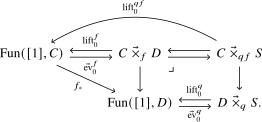 In particular, we see that \(f_*\lift^p_0\) factors through \(\lift^q_0\), and thus it suffices to show that the map
\[
\lift^q_0\vec{\ev}^q_0\lift^q_0 \xrightarrow{\epsilon_q\lift^q_0} \lift^q_0
\]
is an equivalence. But this is immediate from the triangle identities and the fact that the unit \(\id \to \vec{\ev}^q_0\lift^q_0\) of the adjunction \(\lift^q_0 \dashv \vec{\ev}^q_0\) is a natural isomorphism.