Lemma 4.1.6 (Base change). Consider a pullback square of the form
 Then the commutative square
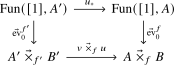 is a pullback square. The dual result for \(\vec{\ev}^f_1\) and \(\vec{\ev}^{f'}_1\) also holds.
Proof
Consider the following commutative diagram:
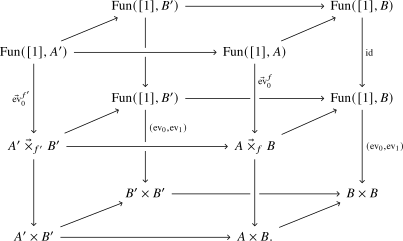 Observe that the bottom square is a pullback square, while the lower vertical squares on the left and right sides are pullback squares by definition of \(A' \vectimes{f'} B'\) and \(A \vectimes{f} B\). It follows by the pasting law of pullback squares that also the middle horizontal square is a pullback square. Since also the upper square at the back and the top square are pullback squares, it thus follows that the upper front square is a pullback square, as desired.