Lemma 4.1.7 (Composition). For functors \(f\colon A \to B\) and \(g\colon B \to C\), there is a commutative diagram
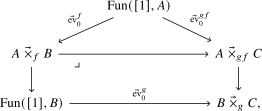 where the bottom square is a pullback square.
Proof
It is easy to verify that the diagram commutes, hence it remains to show that the bottom square is a pullback square. To this end, consider the following commutative diagram:
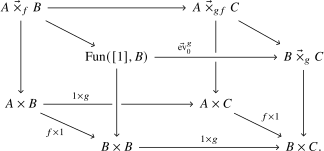 We want to show that the top square is a pullback square. The left square is a pullback square by definition and the bottom square is easily seen to be a pullback square, hence by the pasting law of pullback squares it will suffice to show that the right square is a pullback square. This follows from another instance of the pasting law, applied to the following commutative diagram:
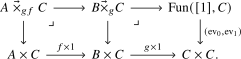 Indeed, by the definitions of \(A \vectimes{gf} C\) and \(B \vectimes{g} C\) the right and outer squares are pullback squares and hence so is the left square.