Proposition 3.6.9. Let \(A\) and \(B\) be two categories. The canonical embedding \(A\sqcup B\hookrightarrow A\star B\) induces an equivalence \[ A^\simeq\sqcup B^\simeq\iso (A\star B)^\simeq\, . \]
Proof
Let \(h\colon A\star B\to[1]\) be the height functor. By
Axiom J.2, there is a pullback square
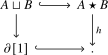 The canonical equivalence \(\partial[1]\iso[1]^\simeq\) from
Axiom C.1 identifies this with a pullback square
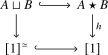 up to the specified comparison. The square formed by the two groupoid-core inclusions and
\(h\) therefore induces a functor
\[
u\colon(A\star B)^\simeq\longrightarrow(A\sqcup B)^\simeq
\iso A^\simeq\sqcup B^\simeq.
\]
The functor \(u\) is an embedding: after composing with the groupoid-core inclusion of
\(A\sqcup B\) and then with \(A\sqcup B\hookrightarrow A\star B\), it agrees with the
groupoid-core inclusion of \(A\star B\). Since these inclusions are embeddings, so is \(u\) by
Lemma 1.6.26.
Applying groupoid cores to \(A\sqcup B\hookrightarrow A\star B\) and using Lemma 2.1.28 gives a section \[ A^\simeq\sqcup B^\simeq\longrightarrow(A\star B)^\simeq \] of \(u\). Hence \(u\) is an equivalence by Lemma 1.6.24.
From Section 3.6, Joins.