Definition 1.7.3. Given another category \(T\), choose an inverse \(v_T\) of the equivalence \(\mathit{u}_T\).
For a functor \(f\colon T\times C\to D\), define its currying by applying \(v_T\):
\[
f_c:=v_T(f)\colon T\longrightarrow\Fun(C,D).
\]
It comes equipped with a commutative diagram as follows:
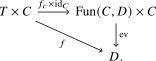
Conversely, given a functor \(g\colon T \to \Fun(C,D)\), we call the composite \[ T \times C \xrightarrow{g \times \id_C} \Fun(C,D) \times C \xrightarrow{\ev} D \] the uncurrying of \(g\) and denote it by \(g^u\). The discussion before shows it is identified with \(\mathit{u}_T(g)\). Similarly, an identification \(\beta\colon g= h\) induces an identification \(\beta^u\colon g^u= h^u\). At the level of mapping animae, uncurrying is the equivalence \[ (-)^u \colon \Map (T,\Fun(C,D))\iso\Map(T\times C,D) \] with inverse defined by currying.