Using mapping animae, we may dualize the definition of a pullback square of categories:
Definition 1.8.1 (Pushout square). A commutative square of categories
 is called a pushout square (or cocartesian) if, for every category \(E\), the induced square
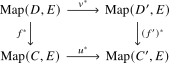 is a pullback square.
Remark 1.8.2. We do not assume in the present metatheory that arbitrary pushouts of categories exist. We do not need this as a metatheoretic axiom, although such pushouts exist in all intended models of our theory. We will eventually prove that the synthetic category \(\Cat\) of small synthetic categories admits small colimits, which in particular provides pushouts of small categories.
Proposition 1.8.3. A commutative square of categories
is a pushout square if and only if, for every category \(E\), the induced square
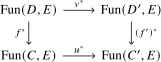 is a pullback square.
Proof
For any category \(T\), the commutative square
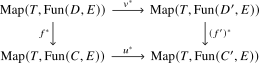 is equivalent to the commutative square
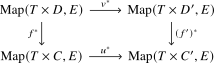 which in turn is equivalent to the square
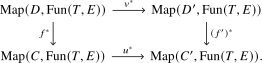 The latter is a pullback square for all \(T\) and \(E\) if and only if it is so for all \(E\) in the special case where \(T=*\)
since there is a canonical equivalence \(E\iso \Fun(*,E)\).
On the other hand,
the first square is a pullback square for all \(T\) if and only if
is a pullback square. This proves the proposition.
Lemma 1.8.4 (Pasting lemma for pushout squares). Consider a commutative diagram
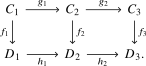 If the left-hand square is a pushout square, then the right-hand square is a pushout square if and only if the outer rectangle is a pushout square.
Proof
This follows immediately by applying Lemma 1.6.11
to the commutative diagrams
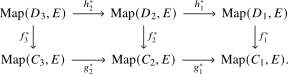 for each \(E\).