Remark 16.2.2. The property for \(A\) to be confluent is equivalent to the following one:
given any morphisms in \(A\) of the form
\(u\colon x\to y\) and \(v\colon x\to z\), the category \(A_{y/}\times_{A_{x/}}A_{z/}\) is
weakly contractible.
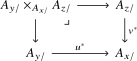 Indeed, an object of \(A_{x/}\) is a pair \((z,v)\) with \(v\colon x\to z\) a morphism in \(A\) and
since \(v^*\colon A_{z/}\to A_{x/}\) is a left fibration whose domain has an initial
object sent to \((z,v)\), there is a canonical equivalence of the form
\[
(A_{x/})_{(z,v)/}\iso A_{z/}
\]
over \(A_{x/}\), so that we have a canonical equivalence
\[
(A_{y/})_{(z,v)/}\iso
A_{y/}\times_{A_{x/}}A_{z/}\, .
\]
Our claim now follows by applying Corollary 9.5.8 with \(C=(A_{x/})\catop\).