Remark 12.4.17. The previous proposition allows a fairly explicit description of the objects and morphisms
of \(\Cat_{\bullet}\), using the equivalence with \(\mathrm{Rep}\).
An object of \(\mathrm{Rep}\) is a right fibration \(p\colon X\to A\) together with a
terminal object \(x\) of \(X\). But then the induced functor \(X_{/x}\to A_{/p(x)}\)
preserves terminal objects and is a morphism of right fibrations over \(A\). Therefore, it is
an equivalence. Since the projection \(X_{/x}\to X\) is an equivalence as well, this means that,
up to equivalence, \(p\) is totally determined by the pair \((A,a)\) consisting of a small synthetic
category \(A\) and of an object \(a\) of \(A\). A morphism in \(\mathrm{Rep}\)
is by definition a commutative square in \(\Cat\) of the form
 where \(a\) is an object of \(A\), \(b\) an object of \(B\), and \(p\) and \(q\)
are the canonical projections.
The functor \(u\) is totally determined by the functor
\[
\tilde{u}\colon A_{/a}\to A\times_B B_{/b}
\]
over \(A\). Since \(q\) is a right fibration, this means that this functor is totally determined by
the image of the terminal object \((a,\id_a)\) in the fiber product \(A\times_B B_{/b}\).
This image must be a pair of the form \((a,v)\) where \(v\colon f(a)\to b\) is
a morphism in \(B\).
In other words, a morphism in \(\Cat_{\bullet}\) is a pair of the form
\[
(f,v)\colon (A,a)\to (B,b)
\]
where \(f\colon A\to B\) is a functor between small categories,
\(a\) is an object of \(A\), \(b\) is an object of \(B\), and \(v\colon f(a)\to b\)
is a morphism of \(B\).
This allows to describe objects and morphisms in any Grothendieck construction
(i.e. in the total category associated to a functor with values in \(\Cat\)).
Indeed, let \(F\colon A\to \Cat\) be a functor from a category \(A\)
to the category of small categories. We can then form the following
pullback square.
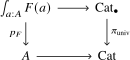 Any object of \(\int_{a : A}F(a)\) will have an image in \(A\).
If we also write \(F(a)\) the category corresponding to \(F(a) : \Cat^\simeq\),
using the pullback square
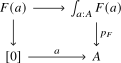 We see that an object of \(\int_{a : A}F(a)\) is a pair \((a,x)\) where \(a\) is an object of \(A\)
and \(x\) an object of \(F(a)\).
A morphism in \(\int_{a : A}F(a)\) is a pair of the form
\[
(u,v)\colon (a,x)\to (b,y)
\]
where \(u\colon a\to b\) is a morphism in \(A\) and \(v\colon F(u)(x)\to y\)
is a morphism in \(F(b)\) (since one can interpret the pair \((F(u),v)\)
as a morphism in \(\Cat_{\bullet}\)).