Proposition 8.8.5. Let \(p\colon C \to S\) be a small cocartesian fibration.
We consider, for each object \(x : S^\simeq\) a subcategory \(W_x\hookrightarrow C_x\)
and assume that, for each morphism \(f\colon x\to y\) in \(S\), the induced
functor \(f_!\colon C_{x}\to C_{y}\) restricts to a functor from \(W_x\) to \(W_y\).
Then there exists a commutative triangle
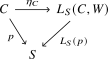 satisfying the following properties:
(1) The functor \(L_S(p)\) is a cocartesian fibration;
(2) For any other small cocartesian fibration \(D \to S\), precomposition with \(\eta_C\) induces an equivalence \[ \eta_C^*\colon \Map_S^{\CoCart}(L_S(C,W), D) \iso \Map_S^{\CoCart,W}(C,D) \] where \(\Map_S^{\CoCart,W}(C,D)\) is the collection of cocartesian functors \(\varphi\colon C\to D\) over \(S\) with the property that, for any object \(x : S^\simeq\), the induced functor on fibers \(\varphi_x\colon C_x\to D_x\) sends all morphisms in \(W_x\) to isomorphisms in \(D_x\).
(3) The formation of \(\eta_C\) and \(L_S(C,W)\) is stable under base change along any functor \(S' \to S\). In particular, for any object \(s : S^\simeq\), the functor \((\eta_C)_s\colon C_s \to L_S(C,W)_s\) induces an equivalence \[ L(C_s,W_s) \iso L_S(C,W)_s\, . \]
Proof
Using cocartesian transport, each morphism \(u\) of \(C\) factors uniquely into a \(p\)-cocartesian morphism \(v\colon x\to y\) followed by a morphism \(w\colon y\to y'\) in the fiber over \(p(y)\). We define \(W\) to have the objects \(x\) that belong to \(W_{p(x)}\) and the morphisms \(u\) between such objects for which the vertical factor \(w\) belongs to \(W_{p(y)}\). The assumption that cocartesian transport restricts to the \(W_x\) implies that \(W\) is closed under composition, that \(W\to S\) is a cocartesian fibration, and that \(W\hookrightarrow C\) is a cocartesian functor over \(S\). The fibers \(W_x\) are small by subcategory closure, so \(W\to S\) is small by (Cat9). Thus directed univalence gives a functor \(F\colon S \to \Pair\).
Then the composite
\[
L\circ F\colon S \to \Cat
\]
classifies a cocartesian fibration \(L_S(p)\colon L_S(C,W) \to S\):
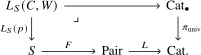 The natural transformation \(\id_{\Pair} \to (L(-))^\flat\)
provides a natural transformation \(F \to (L(F))^\flat\), which, by directed univalence, yields
a cocartesian functor from \(C\) to \(L_S(C,W)\) over \(S\):
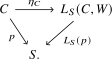 This produces the desired commutative triangle and proves property (1). For (2), we note that postcomposition with the functors \(L\) and \((-)^\flat\) extends to an adjunction
\[
L_S=(L)_*\colon \Fun(S,\Pair) \rightleftarrows \Fun(S,\Cat) \noloc ((-)^\flat)_*
\]
whose unit is induced by the unit map of the adjoint pair \((L,(-)^\flat)\), by
Proposition 4.4.4.
In particular, for functors \(F\colon S \to \Pair\) and \(G\colon S \to \Cat\) the map
\[
\Hom_{\Fun(S,\Cat)}(L\circ F, G) \xrightarrow{(-)^\flat\circ -}
\Hom_{\Fun(S,\Pair)}((L\circ F)^\flat, G^\flat) \xrightarrow{- \circ \eta} \Hom_{\Fun(S,\Pair)}(F,G^\flat)
\]
is an equivalence. The functor \(F\colon S \to \Pair\) corresponds to a small cocartesian fibration \(C \to S\),
equipped with a subcategory \(W\hookrightarrow C\) such that the restriction of \(p\) to \(W\)
remains a cocartesian fibration and the embedding of \(W\) into \(C\) a cocartesian functor over \(S\),
while the functor \(G\colon S \to \Cat\) corresponds to a small cocartesian fibration \(D \to S\). Under directed univalence, the previous functor then translates into the functor
\[
\eta_C^*\colon \Map_S^{\CoCart}(L_S(C,W), D) \iso \Map_S^{\CoCart,W}(C, D),
\]
from part (2), showing that it is an equivalence.
For part (3), we observe that the map \(\eta_C\) can in fact be recovered as a pullback from the universal case \(S = \Pair\) and \(F = \id_{\Pair}\). More precisely, the embedding
\[
\Pair\hookrightarrow\Fun([1],\Cat)\iso
\ul{\CoCart}_{\Cat \times \Cat}(\Cat_{\bullet} \times \Cat, \Cat \times \Cat_{\bullet})
\]
yields a commutative triangle of the form
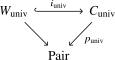 in which \(p_\univ\) as well as its restriction to \(W_\univ\) are cocartesian fibrations and
\(i_\univ\) is a cocartesian functor over \(\Pair\) and an embedding (fiberwise, hence globally as well).
Pulling back the diagram above along \(F\colon S\to \Pair\)
recovers \(W\hookrightarrow C\) over \(S\) and we have canonical pullback squares of
the form:
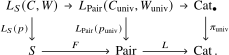 This readily implies
the final statement in part (3).