Proposition 12.2.11. For a functor \(u\colon C \to D\) between small categories, the following conditions are equivalent:
(1) The functor \(u\) is fully faithful.
(2) The functor \(u_!\colon \Fun(C,\An) \to \Fun(D,\An)\) is fully faithful.
(3) The commutative square
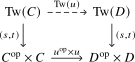 is a pullback square.
(4) The functor \(u\catop\colon C\catop\to D\catop\) is fully faithful.
Proof
The equivalence between (1) and (3) follows because both conditions ask the induced map \(C(x,y) \to D(u(x),u(y))\) to be an equivalence for all objects \(x\) and \(y\) of \(C\). The equivalence between (1) and (4) is Lemma 12.1.12, applied to all pairs of objects. The fact that (4) follows from (2) holds by definition of \(u\catop\). It remains to show that (1) implies (2).
Let \(p\colon X \to C\) be a small left fibration, classified by a functor \(F\colon C \to \An\). We may factor \(u \circ p\) as
 where \(j\) is initial and \(q\) is a left fibration. Then \(q\) is a small left fibration and thus corresponds to a functor \(u_!(F)\colon D \to \An\). The natural transformation \(F \to u^*u_!F\) corresponds to the functor \((p,j)\colon X \to C \times_D Y\), and we have to show this is an equivalence. Since it is a morphism of left fibrations over \(C\), we may equivalently show that for every object \(x\) of \(C\), the induced map
\[
X_x \to Y_{u(x)}
\]
is an equivalence. Now, this map fits into the following commutative square
 and since the vertical functors are both terminal (because left fibrations are proper, by Corollary 9.4.9),
we may equivalently show that the functor \(u_{/x}\) is a weak homotopy equivalence. Since \(u\) is fully faithful, we have a pullback square
 and hence an equivalence \(C_{/x} \iso C\times_D D_{/u(x)}\). It follows that we also have an equivalence \(X_{/x} \iso X\times_D D_{/u(x)}\), and so it will suffice to show that the map
\(j_{/u(x)}\colon X\times_D D_{/u(x)} \to Y_{/u(x)}\) is a weak equivalence. But since this functor is a pullback of \(j\) along the smooth functor \(D_{/u(x)} \to D\), \(j_{/u(x)}\) is an initial functor, and hence in particular a weak equivalence.