Proposition 12.2.3 (Functoriality of twisted arrow categories). There is a functor \[ \Tw\colon\Cat\longrightarrow\Cat \] and a natural transformation \[ (s,t)\colon\Tw\longrightarrow(-)\catop\times\id_{\Cat} \] whose component at a category \(C\) is the left fibration \((s,t)\colon\Tw(C)\to C\catop\times C\) of Definition 12.2.1.
Proof
Recall from Construction 12.1.20 the subcategories \(\CoRep \hookrightarrow \LFib \hookrightarrow \Fun([1],\Cat)\). We may think of the inclusion \(\CoRep\hookrightarrow\Fun([1],\Cat)\) as a natural transformation from the source evaluation \(\ev_0\colon\CoRep\to\Cat\) to the target evaluation
\(\ev_1\colon\CoRep\to\Cat\). Unstraightening gives a cocartesian functor of the form bellow.
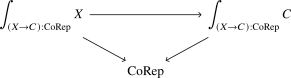 Here the two integrals denote the unstraightenings of \(\ev_0\) and \(\ev_1\),
respectively. It follows from Proposition 12.1.21 that the functor \(\ev_1\colon\CoRep\to\Cat\) is a small cocartesian fibration. By regularity of the universe, we may then compose the two small cocartesian fibrations in the previous diagram with \(\ev_1\) to give two small cocartesian fibrations over \(\Cat\). The displayed functor is then also cocartesian over \(\Cat\): a cocartesian lift for either composite is obtained by first lifting in \(\CoRep\) and then in its unstraightening, and the displayed functor preserves these lifts.
The right-hand total category is the pullback \(\CoRep\times_{\Cat}\Cat_{\bullet}\), formed using \(\ev_1\) and \(\pi_{\univ}\). Its projection to \(\Cat\) is therefore the product of the cocartesian fibrations classifying \((-)\catop\) and \(\id_{\Cat}\). Straightening the displayed functor over \(\Cat\) consequently gives a natural transformation \[ (s,t)\colon\Tw\longrightarrow(-)\catop\times\id_{\Cat}, \] where \(\Tw\colon\Cat\to\Cat\) classifies the left-hand composite fibration.
It remains to identify its component at \(C\). The fiber of \(\CoRep\to\Cat\) over \(C\) is \(C\catop\), and the inclusion into \(\LFib(C)\) is the co-Yoneda embedding by Proposition 12.1.21. Thus the component is \[ \int_{x:C\catop}C_{x/}\longrightarrow C\catop\times C. \] This is a cocartesian functor over \(C\catop\) whose fiber at \(x\) is the left fibration \(C_{x/}\to C\). Transport in \(C\catop\) gives functors between these left fibrations over \(C\), which preserve cocartesian morphisms. Hence Proposition 6.5.15 shows that the displayed functor is a cocartesian fibration. Its fibers are animae, so it is a left fibration, classified by the uncurrying of \(h_{C\catop}\), namely \(\Hom_C\). It therefore agrees with the defining left fibration \(\Tw(C)\to C\catop\times C\).
For a functor \(f\colon C\to D\), cocartesian transport in \(\CoRep\) is given by left Kan extension. Its unit on a corepresentable corresponds to the canonical functor \(C_{x/}\to D_{f(x)/}\) from Proposition 12.1.9. Consequently, \(\Tw(f)\) restricts to this functor on the source fibers and sends \(\id_x\) to \(\id_{f(x)}\).