Definition 3.1.15. Let \(C\) and \(D\) be categories, and assume that they come equipped with collections of morphisms \(m\colon M \hookrightarrow \Map([1],C)\) and \(n\colon N \hookrightarrow \Map([1],D)\). A functor \(f\colon C \to D\) is said to send morphisms in \(M\) to morphisms in \(N\) if there exists a map \(\tilde{f}\colon M \to N\) making the following diagram commute:
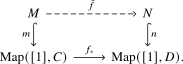 Since the map \(n\) is an embedding, the map \(\tilde{f}\colon M \to N\) is unique if it exists.