Remark 8.7.2. In what follows, we will use the following previously established facts about the category \(\Cat\):
• The walking morphism \([1]\) is small and thus defines an object \([1] \in \Cat\);
• There is a pullback functor \(\Fun(\pullback,\Cat) \to \Cat\) right adjoint to the constant diagram functor, see Corollary 8.5.9;
• There is a product functor \(- \times -\colon \Cat \times \Cat \to \Cat\) right adjoint to the diagonal \(\Cat \to \Cat \times \Cat\);
• For every \(d \in \Cat\), the functor \(- \times d\colon \Cat \to \Cat\) admits a right adjoint \((-)^d\colon \Cat \to \Cat\).
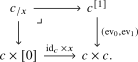
• For any object \(c\) in \(\Cat\) and any object \(x\) of \(c\) (i.e. any morphism \(x\colon [0]\to c\)), one can define the slice \(c_{/x}\) by forming the following pullback square in \(\Cat\).
• An object \(x\) of an object \(c\) of \(\Cat\) is terminal if the projection \(c_{/x}\to c\) is an equivalence.