Proposition 8.7.15 (Products in cocartesian unstraightenings). Let \(p\colon E\to B\) be a small cocartesian fibration classified by a functor \(F\colon B\to\Cat\). If \(B\) admits finite products and \(F\) preserves them, then \(E\) admits finite products and \(p\) preserves them. More precisely, let \((X_a\in F(b_a))_{a\in A}\) be a finite family, and write \(b=\prod_{a\in A}b_a\). Under the equivalence \[ F(b)\simeq\prod_{a\in A}F(b_a), \] let \(X\in F(b)\) correspond to the tuple \((X_a)_{a\in A}\). Then the \(p\)-cocartesian lifts \(X\to X_a\) of the product projections \(b\to b_a\) exhibit \(X\) as the product of the \(X_a\) in \(E\).
Proof
For an object \(Z\in F(c)\), the proposed product cone gives a commutative square
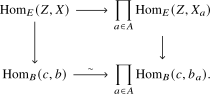 For every \(f\colon c\to b\), the induced map on fibers is
\[
\Hom_{F(b)}(f_!Z,X)\longrightarrow
\prod_{a\in A}\Hom_{F(b_a)}((\pr_a f)_!Z,X_a).
\]
Under the product equivalence for \(F(b)\), the object \(f_!Z\) corresponds to the tuple \(((\pr_a f)_!Z)_{a\in A}\), by compatibility of cocartesian transport with composition. Thus the map on fibers is an equivalence. The bottom horizontal map is an equivalence because \(b\) is the product of the \(b_a\), so the top horizontal map is an equivalence as well. This proves that the chosen lifts exhibit \(X\) as the product of the \(X_a\). Their images under \(p\) form the product cone with vertex \(b\).