Theorem 12.5.5 (Hom animae of functor categories). Let \(C\) be a locally small category and let \(I\) be a small category. Then the hom animae of \(\Fun(I,C)\) may be computed as \[ \Hom_{\Fun(I,C)}(F,G) \simeq \lim_{u : i \to j} \Hom_C(F(i),G(j)), \] where the right-hand side is defined as the limit of the composite functor \[ \Tw(I) \xrightarrow{(s,t)} I\catop \times I \xrightarrow{F\catop \times G} C\catop \times C \xrightarrow{\Hom_C} \An. \] In particular, the category \(\Fun(I,C)\) is again locally small.
Proof
Choose a universe so that \(C\) is small, and consider the fully faithful functor \(h_C\colon C \to \PSh(C)\). Then \(h_C\colon \Fun(I,C) \to \Fun(I,\PSh(C))\) is fully faithful as well. Given \(F,G\colon I \to C\), we have
\[
\Hom(F,G) \simeq \Hom(h_C(F),h_C(G)).
\]
Consider the following commutative diagram:
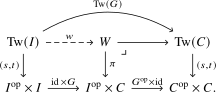 We showed in Lemma 12.2.7
that the unique functor \(w\) obtained from this diagram is an initial functor. Let \(e\) be the terminal object of \(\Fun(\Tw(I),\An)\), so that we have an identification
\[
\Hom_I = (s,t)_!(e)
\]
of functors \(I\catop \times I \to \An\). It follows from the diagram that there is an identification
\[
\Hom_C(G(-),-) = (G\catop \times \id_C)^* \Hom_C(-,-) \simeq (\id_{I\catop} \times G)_! \Hom_I(-,-) \simeq (\id_{I\catop} \times G)_!(s,t)_!(e)
\]
of functors \(I\catop \times C \to \An\). The covariant Yoneda embedding
\(C\catop\to\Fun(C,\An)\) is fully faithful. Applying it objectwise to
\(F\catop\) and \(G\catop\), and then using the preceding identification and
the two adjunctions, gives
\begin{align*}
\Hom(F,G) &\simeq \Hom(\Hom_C(G(-),-), \Hom_C(F(-),-)) \\
&\simeq \Hom((\id_{I\catop} \times G)_!(s,t)_!(e), \Hom_C(F(-),-)) \\
&\simeq \Hom(e, (s,t)^*(\id_{I\catop} \times G)^*\Hom_C(F(-),-)) \\
&\simeq \lim_{\Tw(I)} (s,t)^*((i,j) \mapsto \Hom_C(F(i),G(j))).
\end{align*}