Corollary 3.1.11. In the situation of Axiom H, the functor \(\Map([1],\lra{M}_C) \to M\) is an equivalence.
Proof
Applying the universal property of \(\lra{M}_C\) to \(D = [1]\), and using the equivalence \(\Map([1],[1]) \simeq \{\id_0, \id_1,\can\}\) from Remark 2.1.29, we obtain a pullback square
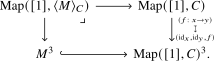 The claim now follows from the fact that the map \(M \hookrightarrow \Map([1],C)\) is an embedding and that \(M\) is closed under composition, so that \(f\) lies in \(M\) if and only if each of \(\id_x, \id_y,f\) lie in \(M\).