Lemma 12.1.15. If \(p\colon X\to C\) is a right (left) fibration, then \(p\catop\colon X\catop\to C\catop\) is a left (right) fibration.
Proof
Let us assume that \(p\) is a right fibration.
We have to check that the square
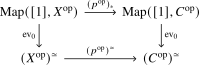 is a pullback square. Identifying \(C^\simeq\) and \((C\catop)^\simeq\), this square
is a diagram of the form below.
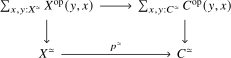 By virtue of Lemma 12.1.12, this square is equivalent to
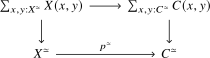 which in turn is equivalent to the commutative square
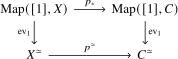 and the latter is a pullback square, since \(p\) is a right fibration.
The dual case is proven exactly in the same way, simply by exchanging the roles of the functor
\(\ev_0\) and \(\ev_1\).