Lemma 12.3.21. Let \(C\) be a locally small category, let \(F\colon C\catop\to\An\) be a presheaf, and let \(y\) be an object of \(C\). Suppose that the following conditions hold.
(i) For each object \(x\) of \(C\), there is a morphism \[ s_x\colon \Hom_C(x,y)\to F(x)\, . \]
(ii) For each morphism \(u\colon x'\to x\) in \(C\), the square
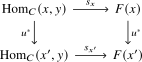 commutes in \(\An\).
Then there is a unique morphism of presheaves \[ s\colon\Hom_C(-,y)\to F \] equipped with an identification \(\alpha\colon s(y)(\id_y)\simeq s_y(\id_y)\). The component of \(s\) at \(x:C^{\simeq}\) is \(s_x\). In particular, if each \(s_x\) is an isomorphism, then \(F\) is representable.
Proof
By the Yoneda lemma, evaluation at \(\id_y\) defines an isomorphism of animae \[ \Hom_{\PSh(C)}(\Hom_C(-,y),F)\iso F(y). \] Its fiber over \(s_y(\id_y)\) is therefore contractible. This fiber is precisely the anima of pairs \((s,\alpha)\), proving the uniqueness assertion.
Given an arbitrary morphism \(u\colon x\to y\), we may compute \[ s(x)(u)\simeq F(u)(s(y)(\id_y)) \simeq F(u)(s_y(\id_y))\simeq s_x(u), \] where we used the naturality of \(s\), the identification \(\alpha\), and condition (ii) evaluated at \(\id_y\). Taking \(u\) to be the universal term of the anima \(\Hom_C(x,y)\) gives an isomorphism of maps \(s(x)\simeq s_x\).
If every \(s_x\) is an isomorphism, then \(s\) is an isomorphism by the pointwise criterion for natural isomorphisms, and it follows that \(F\) is represented by \(y\).