Corollary 12.6.4 (Yoneda density). Let \(C\) be a small category and let \(F\colon C\catop \to \An\) be a functor corresponding to a right fibration \(p_F\):
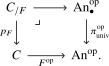 Then \(F\) is canonically a colimit of representable presheaves: there is a preferred isomorphism
\[
\underset{(x,s)\colon C_{/F}}{\colim}\, h_C(x) \iso F
\]
in \(\PSh(C)\).
Proof
The functor \(p_F\colon C_{/F} \to C\) induces an adjunction
\[
(p_F)_!\colon \PSh(C_{/F}) \rightleftarrows \PSh(C) \noloc p_F^*.
\]
By Theorem 12.6.3 the colimit \(\colim_{(x,s) \in C_{/F}} h_{C_{/F}}(x,s)\) is a terminal object \(e_{C_{/F}}\) in \(\PSh(C_{/F})\), hence it follows that
\begin{align*}
\colim_{(x,s) \in C_{/F}} h_C(x)
&\simeq \colim(h_C \circ p_F)
\simeq \colim((p_F)_!h_{C_{/F}})\\
&\simeq (p_F)_!(\colim h_{C_{/F}})
\simeq (p_F)_!(e_{C_{/F}}).
\end{align*}
So it remains to show that there exists a canonical isomorphism \((p_F)_!(e_{C_{/F}}) \iso F\). To see this, consider the diagram
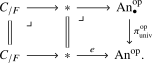 The bottom functor is the one corresponding to \(e_{C_{/F}}\colon C_{/F}\catop \to \An\), hence its associated right fibration is the identity functor on \(C_{/F}\). The left Kan extension is obtained by factoring its composite with \(p_F\) into a terminal functor followed by a right fibration. Since \(p_F\) is already a right fibration, this factorization is
 Hence the functor \((p_F)_!(e_{C_{/F}})\colon C\catop \to \An\) is the functor classifying the right fibration \(p_F\colon C_{/F} \to C\), which is \(F\).
From Section 12.6, Yoneda density and categories of elements.