Lemma 2.4.9. Consider functors \(f\colon X \to C\) and \(g\colon Y \to C\) and assume that \(X\) and \(Y\) are groupoids. Then the pullback \(X \times_C Y\) is a groupoid.
Proof
The functor \(X \times_C Y \to \Ar(X \times_C Y)\) factors as
\[
X \times_C Y \iso X \times_{\Ar(C)} Y \iso \Ar(X) \times_{\Ar(C)} \Ar(Y) \simeq \Ar(X \times_C Y).
\]
Here the second functor is an equivalence since \(X\) and \(Y\) are groupoids. The last equivalence is Lemma 1.7.11. Finally, we claim that the first functor is a pullback of the diagonal of the embedding \(i\colon C \to \Ar(C)\) from Corollary 2.3.7 and hence is an equivalence. To see this, consider the following commutative diagram:
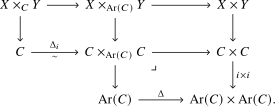 The right bottom square, the right outer rectangle and the top outer rectangle are pullback squares by Lemma 1.6.13. It thus follows from Lemma 1.6.11 that also the top left square is a pullback square.
From Section 2.4, Groupoids.