Animae enter the foundational language primitively as homotopy-coherent collections, whereas the groupoid condition is a property of a category expressed by invertibility of its morphisms. The two notions enter the theory independently. The following axiom asserts that they determine the same class of categories, allowing us to pass between collection-oriented anima language and structural groupoid arguments.
Axiom G (Groupoid recognition axiom). A category is an anima if and only if it is a groupoid.
Proposition 2.5.1. For any anima \(X\) and any category \(A\), the canonical functor \[ \imath_{A,X}\colon\Map(A,X)\iso\Fun(A,X) \] is an equivalence.
Proof
By the groupoid recognition axiom and Lemma 2.4.7, the category \(\Fun(A,X)\) is an anima. The claim follows from Propositions 1.7.16 and 1.4.15.
Lemma 2.5.2. For functors \(X\to C\) and \(Y\to C\) with \(X\) and \(Y\) animae, the pullback \(X\times_C Y\) is an anima.
Proof
This follows from Lemma 2.4.9 and the groupoid recognition axiom.
Corollary 2.5.3. Let \(C\) be a category. Then the functor \(\imath_C\colon C^{\simeq} \to C\) is an embedding.
Proof
We need to show that the diagonal \(C^{\simeq} \to C^{\simeq} \times_C C^{\simeq}\) is an equivalence. Its source is an anima, and its target is an anima by Lemma 2.5.2. By Proposition 1.4.11, it therefore suffices to show that for every anima \(Z\) the induced map \[ \Map(Z,C^{\simeq}) \to \Map(Z,C^{\simeq} \times_C C^{\simeq}) \simeq \Map(Z,C^{\simeq}) \times_{\Map(Z,C)} \Map(Z,C^{\simeq}) \] is an equivalence, i.e. we need to show that the map \(\Map(Z,C^{\simeq}) \to \Map(Z,C)\) is an embedding. But this map is even an equivalence by Corollary 1.4.13.
Corollary 2.5.4. The empty category \(\emptyset\) is an anima. For animae \(X\) and \(Y\), the coproduct \(X\sqcup Y\) is an anima.
Proof
The empty category is an anima by Lemma 2.4.11 and the groupoid recognition axiom.
Put \(S:=X\sqcup Y\), with inclusions \(i_X\colon X\to S\) and \(i_Y\colon Y\to S\). By Corollary 1.4.13, these factor through the core inclusion \(\imath_S\colon S^\simeq\to S\): there are functors \(\widetilde{i}_X\colon X\to S^\simeq\) and \(\widetilde{i}_Y\colon Y\to S^\simeq\) with identifications \(\imath_S\circ\widetilde{i}_X=i_X\) and \(\imath_S\circ\widetilde{i}_Y=i_Y\). Their copairing \(s:=\lra{\widetilde{i}_X,\widetilde{i}_Y}\colon S\to S^\simeq\) satisfies \[ \imath_S\circ s =\lra{\imath_S\circ\widetilde{i}_X,\imath_S\circ\widetilde{i}_Y} =\lra{i_X,i_Y} =\id_S. \] Thus \(S\) is a retract of the anima \(S^\simeq\). By the recognition axiom, \(S^\simeq\) is a groupoid, so \(S\) is a groupoid by Lemma 2.4.8. Recognition then shows that \(S\) is an anima.
Corollary 2.5.5. Let \(X\) and \(Y\) be groupoids. Then their disjoint union \(X \sqcup Y\) is a groupoid.
Proof
By the recognition axiom, \(X\) and \(Y\) are animae. Their coproduct is an anima by Corollary 2.5.4, hence a groupoid by recognition.
Lemma 2.5.6. For any two categories \(C\) and \(D\), the canonical map \[ \Ar(C) \sqcup \Ar(D) \to \Ar(C \sqcup D) \] is an equivalence.
Proof
When \(C = * = D\), we have \(\Ar(*) \simeq *\) and the statement says that the map \(* \sqcup * \to \Ar(* \sqcup *)\) is an equivalence. By Corollary 2.5.4, \(*\sqcup *\) is an anima, hence a groupoid by the recognition axiom. The claim follows, since for a groupoid \(X\) the functor \(X \to \Ar(X)\) is an equivalence. For arbitrary \(C\) and \(D\), it follows from Lemma 1.7.11 that there are pullback squares
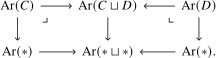 The claim thus follows from Lemma 1.6.16.