Definition 3.5.10. Let \(p\colon C \to S\) and \(q\colon D \to S\) be two functors and assume that \(p\) is an exponentiable functor. We define the relative functor category \(\ulFun_S(C,D) \to S\) as
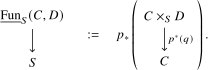 It comes equipped with an evaluation map
\[
\ev\colon \ulFun_S(C,D) \times_S C \to D
\]
over \(S\) satisfying the property that for every other functor \(E \to S\) the composite functor
\[
\Map_S(E,\ulFun_S(C,D)) \xrightarrow{- \times_S C} \Map_S(E \times_S C, \ulFun_S(C,D) \times_S C) \xrightarrow{\ev \circ -} \Map_S(E \times_S C, D).
\]
is an equivalence. In other words, \(\ulFun_S(C,D)\) is an ‘internal hom object’ or ‘exponential object’ for categories over \(S\).
From Section 3.5, Dependent products along exponentiable functors.